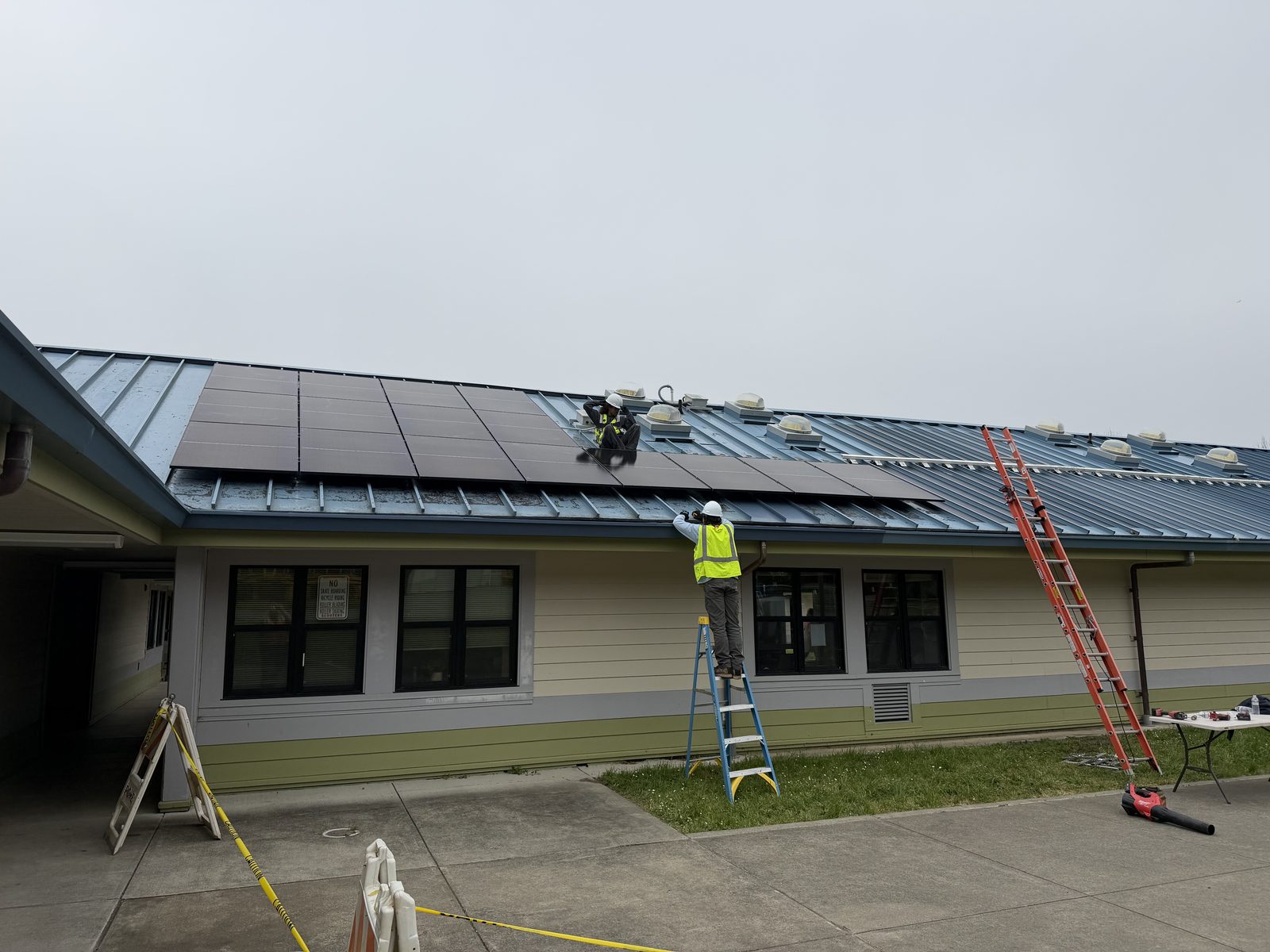
This one is close to our family’s heart. Karolyn and Walter care about clean, homegrown power and about helping people keep the lights on when the grid goes down. We’ve put this page together to explain it the way we would at your kitchen table: honestly, in plain words, with sources you can check.
Our part is the electrical: panels, interconnections, batteries, backup, EV charging, repairs and inverter replacements, plus the permit, inspection and PG&E paperwork. For a quick overview of the service, see our solar and battery service page. If you’re planning a whole connected home, our smart home page covers how energy fits in.
What we do
- New solar, electrical sidePanel readiness, the interconnection, disconnects, labels, the permit and inspection.
- Home batteries and backupBattery storage with a backed-up loads panel or whole-home backup, and the switching that keeps you safe.
- Adding a battery to existing solarChecking your inverter, panel and utility plan, then adding storage the right way.
- Main panel upgradesWhen the busbar can’t take any more solar, a new panel or another code-compliant connection.
- Solar repair and troubleshootingSystems that stopped producing, tripped breakers, failed connectors, ground faults and monitoring that went dark.
- Inverter replacementReplacing a failed inverter with compatible equipment, including rapid shutdown requirements.
- EV charging with solarChargers that can use daytime solar, load management and panel planning.
- Generators alongside solarStandby and portable generator hookups that work safely with a solar and battery system.
- Remove and reinstall for re-roofingTaking panels down and putting them back the right way, with the wiring checked.
- Permits, PG&E and PTOInterconnection applications, inspections and the permission to operate before anything turns on.
How home solar and batteries work
Solar panels turn sunlight into direct current (DC) electricity (DOE). An inverter turns that into the alternating current (AC) your home and the grid use (DOE). Your home uses the solar power first; extra can charge a battery or flow out to the grid through a two-way meter. At night you draw from the battery or the grid.
- 1Panels turn sunlight into DC electricity (DOE).
- 2The inverter converts DC to the AC your home uses (DOE).
- 3A battery can charge from solar directly on the DC side or after conversion to AC.
- 4The two-way meter measures what you buy and what you send to the grid.
- 5In an outage, the system has to disconnect from the grid before it can power your backed-up loads.
Inverters: string, micro and hybrid
The inverter is one of the most important parts of a solar system. Here are the common types for homes:
| Type | How it works | Good to know |
|---|---|---|
| String inverter | A group (string) of panels feeds one inverter. | Cost-effective; shading or a problem on one panel can pull down the whole string (DOE). Often paired with panel-level devices for rapid shutdown. |
| Microinverters | A small inverter on each panel. | Shade or damage on one panel doesn’t drag the others down; can cost more (DOE). AC power leaves the roof. |
| Hybrid (battery-ready) | One unit handles solar and a battery, charging it on the DC side. | Neat when you plan a battery from the start. Check that the battery you want is compatible. |
Battery systems that keep power on in an outage rely on inverters designed to run without the grid. Grid-tied solar alone normally shuts down when the grid does.
California net billing (NEM 3.0) and why batteries matter
For PG&E customers, new solar interconnection applications since April 15, 2023 go on the Net Billing Tariff, which PG&E calls the Solar Billing Plan. In plain words:
- Your own use comes first. Solar power serves your home before anything goes to the grid.
- Exports earn hourly values. Energy you send out is credited at values set from the CPUC’s avoided cost calculator. They change by month and hour, are usually below the retail price, and can be higher on some late-summer evenings (CPUC).
- Batteries add value. The CPUC notes that storing solar and using or exporting it at high-value hours helps get the most from a system.
- Electrification rate. Net billing customers go on an electrification time-of-use rate (E-ELEC for PG&E residential customers, per Schedule NBT).
- Monthly bills, yearly true-up. You pay charges monthly and settle energy at an annual true-up.
- Lock-ins. Per the CPUC, residential customers applying through the end of 2027 lock in their export value schedule for nine years, and PG&E and SCE residential customers applying before the end of 2027 get an extra export adder (not for solar required by the building code).
| Older net metering (NEM 1 or 2) | Net Billing Tariff | |
|---|---|---|
| Who | Systems approved before the change; legacy periods run with the system, even if the home sells | New applications since April 15, 2023 |
| Exports credited | Close to retail | Hourly export values, usually below retail |
| Best strategy | Size to offset yearly use | Use your own solar, store the extra, and shift to evening |
| Battery value | Mainly backup | Backup and everyday savings |
Already on an older plan? Be careful before adding panels: per PG&E, increasing system size by 1 kW or 10% can move you to the Solar Billing Plan. Repairs and like-for-like replacements are a different story; ask before you change anything. More in our net billing guide.
Sizing basics: kW vs. kWh
Two units cover almost everything. kW (kilowatts) is power: how much you’re using or making right now. kWh (kilowatt-hours) is energy: how much over time. A 1 kW load running for 10 hours uses 10 kWh.
| Question | Unit | Where to find it |
|---|---|---|
| How much energy does my home use? | kWh per month or year | Your PG&E account shows 12 months of usage. |
| How big is the solar system? | kW (DC panel rating) | Your proposal or the panel labels. |
| How much can a battery store? | kWh (usable) | The battery spec sheet. |
| What can it run at once? | kW (continuous output) and surge | The battery or inverter spec sheet. Well pumps and AC units need surge. |
For backup, a simple estimate is usable kWh divided by the average kW you’ll draw. A battery with 10 kWh usable running about 1 kW of essentials lasts roughly 10 hours, before any solar recharge. Try our battery backup calculator for your own numbers. For solar production, the national lab’s free PVWatts tool can estimate what panels would make at your address; real proposals should show their assumptions.
Main panel upgrades and the 120% rule
When solar back-feeds a panel through a breaker, the code limits how much can go onto the busbar. Paraphrasing NEC 705.12: 125% of the inverter’s output current plus the main breaker rating shouldn’t exceed 120% of the busbar rating, with the solar breaker at the opposite end from the main.
Example: a 200 A busbar with a 200 A main leaves 40 A of room (240 − 200). Divided by 1.25, that’s about 32 A of continuous inverter output. Larger systems or a battery can push past that.
If you’re over, the options include a smaller main breaker (only if a load calculation says the home can live with it), a connection on the supply side of the main, a panel with a larger busbar, or a listed power control system. Older or problem panels are often worth replacing anyway. More in our panel readiness guide, the solar code article with a 120% calculator, and panel upgrades.
Rapid shutdown and safety labels
Rooftop solar keeps making voltage whenever the sun is up. Rapid shutdown (NEC 690.12, paraphrased) requires roof-mounted systems to be able to drop the voltage in conductors on and near the array quickly when a shutdown switch is used, to protect firefighters. It’s why you’ll see a labeled switch and signs near the service. When an inverter or panel-level device is replaced, we make sure rapid shutdown still works with the new equipment.
Solar repair and inverter replacement
Solar should mostly take care of itself, so when production drops it’s easy not to notice. Signs something’s wrong:
- The app or monitoring shows zero or much lower production on sunny days, or has stopped reporting.
- An inverter light shows red, orange or an error code.
- A solar breaker or disconnect is off or keeps tripping.
- Your bill went up and nothing else changed.
We check the simple things first: breakers, disconnects and the monitoring connection. Then connectors, wiring, ground faults and the inverter itself. If the inverter has failed, we look for compatible replacement equipment, keep rapid shutdown working, and handle the permit and any utility paperwork. Inverters and panel-level electronics often have warranties, so dig out your paperwork, and we’ll help you figure out what’s covered.
Re-roofing? Panels usually need to come off and go back on. We can remove, store if needed, and reinstall them, and check the wiring while it’s exposed.
Adding a battery to existing solar
Batteries can be added later in two main ways. AC-coupled batteries have their own inverter and connect on the AC side, so they work with most existing systems. DC-coupled batteries share a hybrid inverter with the panels. As DOE puts it, solar can charge a battery directly over DC or after conversion to AC.
- Backed-up loads panel or whole home? Many systems back up a separate panel with essentials; whole-home backup needs more battery and planning.
- Panel room. Another back-fed breaker can run into the 120% rule.
- Location. Fire and building codes limit where and how much battery can go in a home; see NEC 706 and NFPA 855 basics.
- Utility plan. Adding storage needs a PG&E interconnection application, and older-plan customers should ask how it affects their plan.
EVs and solar
An EV is one of the bigger loads a home can add, and a natural match for solar. Charging at midday when the sun is strong, or at the cheapest time-of-use hours, gets the most from your system. Load management or power-sharing chargers can often avoid a panel upgrade. Some newer cars and chargers can send power back to a home in an outage; that only works with equipment made and approved for it and the same safe disconnect from the grid as any backup source. See EV charger installation and can my panel handle an EV charger?.
PSPS and wildfire outages
In the foothills we all know the drill. Public Safety Power Shutoffs can turn power off ahead of high fire-risk weather, sometimes for more than a day. A few honest thoughts from us:
- Battery plus solar is quiet, needs no fuel and recharges when the sun is out, but a few cloudy days or big loads can drain it.
- A generator runs as long as it has fuel, which suits long outages. Some homes use both.
- Pick your essentials: fridge, lights, internet, well pump, medical equipment. That decides the size.
- Never back-feed a home with a generator through an outlet. Use a transfer switch or interlock.
More on generators and battery backup and standby generator vs battery.
Simple maintenance
0 of 8 done
Renewable energy basics: sun, wind, water and storage
- Solar. Photovoltaic panels turn sunlight straight into electricity (DOE).
- Wind. Wind turns turbine blades around a rotor, which spins a generator (DOE).
- Hydro. Flowing water spins turbines connected to generators (DOE). This one is part of our region’s story: per PG&E, its hydroelectric system traces back to the Gold Rush, draws on more than 100 reservoirs mostly high in the Sierra Nevada, and has 67 powerhouses. Long-distance power in California started with Sierra water, which we cover in our history of electricity.
- Storage. Batteries, at home and at grid scale, save energy for when the sun is down and the wind is still.
Incentives: where things stand (Nov 2026)
We want to be straight with you, because a lot of older articles are now out of date:
- Federal credit. According to the IRS, the Residential Clean Energy Credit doesn’t apply to expenditures made after December 31, 2025, and an expenditure counts as made when installation is completed.
- SGIP. As of early November 2026, the SGIP program metrics showed the general-market residential storage budget closed, with income-qualified equity funding limited and waitlisted in some areas, including PG&E.
Please check those official sites, or a tax professional, before counting on any incentive. We don’t sell incentives, and we never build a quote around one that may not exist.
What working with us looks like
- Honest numbersNo invented savings. We show our assumptions and point you to the official sources.
- Safety firstRapid shutdown, labels, proper disconnects and a safe way to back up your home.
- Permits and PG&E handledPermit, inspection, interconnection and PTO, start to finish.
- A phone that gets answeredWalter answers his own phone nearly all the time, 24/7.
Call (530) 401-7419 any time, or request a free estimate. A new battery, an inverter that quit or just questions, we’ll give you an honest answer.
How the job goes
- 1Call or send a request
Call (530) 401-7419 or send a request. Tell us whether it’s a new system, a battery, a repair or just questions.
- 2Look at your bills and your panel
Your last 12 months of usage tells us how much energy you use; your panel tells us what it can safely take.
- 3Honest options
We explain the choices in plain words. If a smaller step makes more sense, we’ll say so.
- 4Permit, install, inspection
We pull the permit, do the work, meet the inspector and file with PG&E.
- 5Permission to operate
Nothing gets turned on for good until PG&E gives permission. Then we show you how it all works.
Permits, inspection and PG&E
Inside Auburn city limits, electrical permits come from the City of Auburn Building Division, which takes permit applications online. In unincorporated areas, such as North Auburn, it’s Placer County Building Services. Elsewhere it’s that city or county’s building department. We pull the permit, schedule the inspection and meet the inspector.
Solar and batteries also need PG&E’s approval to connect. The interconnection process usually goes: application, permit and installation, inspection, then permission to operate (PTO). A system shouldn’t be switched on for normal use before PTO. See PG&E’s getting-started page for the current steps.
From our Google reviews
… I had two damaged solar panels that needed replacing. Unfortunately the manufacturer had gone bankrupt. Walter went the extra mile, searched on the internet and found some in Los Angeles.
… Quality work at a reasonable price by skilled craftsmen. Glad I found them. Will use on my future projects. Performed routine maintenance on my Generac emergency generator.
5.0 on Google · 108 reviews Read all our reviews on Google →
Common questions
Does solar still make sense in California after NEM 3.0?
It can, but the math changed. Under the Net Billing Tariff, solar energy you use yourself is worth the most, and exports are credited at values that change by hour and are usually below retail. That’s why batteries matter more now. Ask any installer what export values they assumed.
Will my solar work during a power outage?
Most grid-tied solar without a battery shuts off when the grid goes down, to keep line workers safe. To keep power during outages you need a battery or other backup and equipment designed to run without the grid.
Can I add a battery to my existing solar?
Usually, yes. We check your inverter, panel and utility plan first. If you’re on an older net metering plan, ask before adding panels: PG&E says growing a system by 1 kW or 10% can move it to the newer billing plan.
Is there still a federal tax credit for home solar?
According to the IRS, the Residential Clean Energy Credit doesn’t apply to expenditures made after December 31, 2025, and an expenditure counts when installation is completed. Please check irs.gov or a tax professional for your situation.
Is SGIP still available for home batteries?
As of early November 2026, SGIP’s program metrics showed the general-market residential storage budget closed, with income-qualified equity funding limited and waitlisted in some areas. Check selfgenca.com for the current status.
Do I need a new panel for solar?
Not always. The 120% rule limits how much solar can back-feed a panel’s busbar. If you’re over, options include a main breaker derate, a supply-side connection or a new panel. We’ll check.
Do you repair solar systems you didn’t install?
Yes. Troubleshooting, repairs and inverter replacements on existing systems are a big part of what we do.
Are estimates free?
Yes. Estimates are free. We’re licensed C-10 electrical contractor #1081222, and we work throughout California.
Request a free quote
Free estimates, no pressure. Tell us a little about the job and we’ll get back to you. Or call (530) 401-7419, answered 24/7.
Sources
- City of Auburn Building Division www.auburn.ca.gov
- Placer County Building Services www.placer.ca.gov
- PG&E: How interconnection works when installing solar help.pge.com
- PG&E: Getting started with solar www.pge.com
- U.S. DOE: How does solar work? www.energy.gov
- U.S. DOE: Inverters and grid services basics www.energy.gov
- CPUC: Net Energy Metering and Net Billing www.cpuc.ca.gov
- PG&E: Electric Schedule NBT (Net Billing Tariff) www.pge.com
- PG&E: Solar Billing Plan FAQ www.pge.com
- PG&E: Public Safety Power Shutoffs (PSPS) www.pge.com
- U.S. DOE: How a wind turbine works www.energy.gov
- U.S. DOE: How hydropower works www.energy.gov
- PG&E: Hydroelectric system www.pge.com
- IRS: Residential Clean Energy Credit www.irs.gov
- Self-Generation Incentive Program (SGIP): Program metrics www.selfgenca.com
Rules, rates and incentives change. Everything here was checked against official sources on Nov 2, 2026 and is summarized in plain words, not quoted. Code sections are paraphrased. We don’t give tax advice; please confirm incentives with the IRS, the program or a tax professional. Checked against the sources above in November 2026.