IES Learn · History

The Story of Electricity

From rubbed amber to the panel in your garage. 32 stops on an interactive timeline, from the first experiments to how power came to California and the Sierra foothills. Every stop links to its sources.

Electricity did not arrive all at once. It came from centuries of curious people, careful experiments, a few lucky accidents and plenty of arguments. Here is the story in plain English, stop by stop. Tap a stop to open it. Where historians disagree, we say so.

Era 1

From amber to the power grid

c. 600 BC – 1924

How curious people turned a strange spark into the electricity in your walls: the experiments, the first power stations, the AC-versus-DC fight, and the first safety rules.

  1. c. 600 BC (as told later)

    Amber and the story of Thales

    Long before anyone said “electricity,” people noticed something odd about amber, the fossil tree resin: after rubbing, it could pull on light things. Ancient writers connect this to the Greek thinker Thales of Miletus. None of his own writing survives, though. What we have comes from later authors, who say Thales reasoned from the magnet and from amber that even “lifeless” things could move other things. So treat this one as an old tradition, not a lab notebook.

    Neat fact Our word “electric” comes from ēlektron, the Greek word for amber.
    Link to this stop
  2. William Gilbert names the “electric” force

    William Gilbert, an English physician who served Queen Elizabeth I, published De Magnete in 1600. He tested many materials, showed that the Earth itself behaves like a giant magnet, and was the first to use terms like “electric force,” “electric attraction” and “magnetic pole.” He is often called the father of electrical studies.

    Neat fact Gilbert coined the Latin word electricus, meaning “like amber.”

    Link to this stop
  3. Franklin, a kite and a key

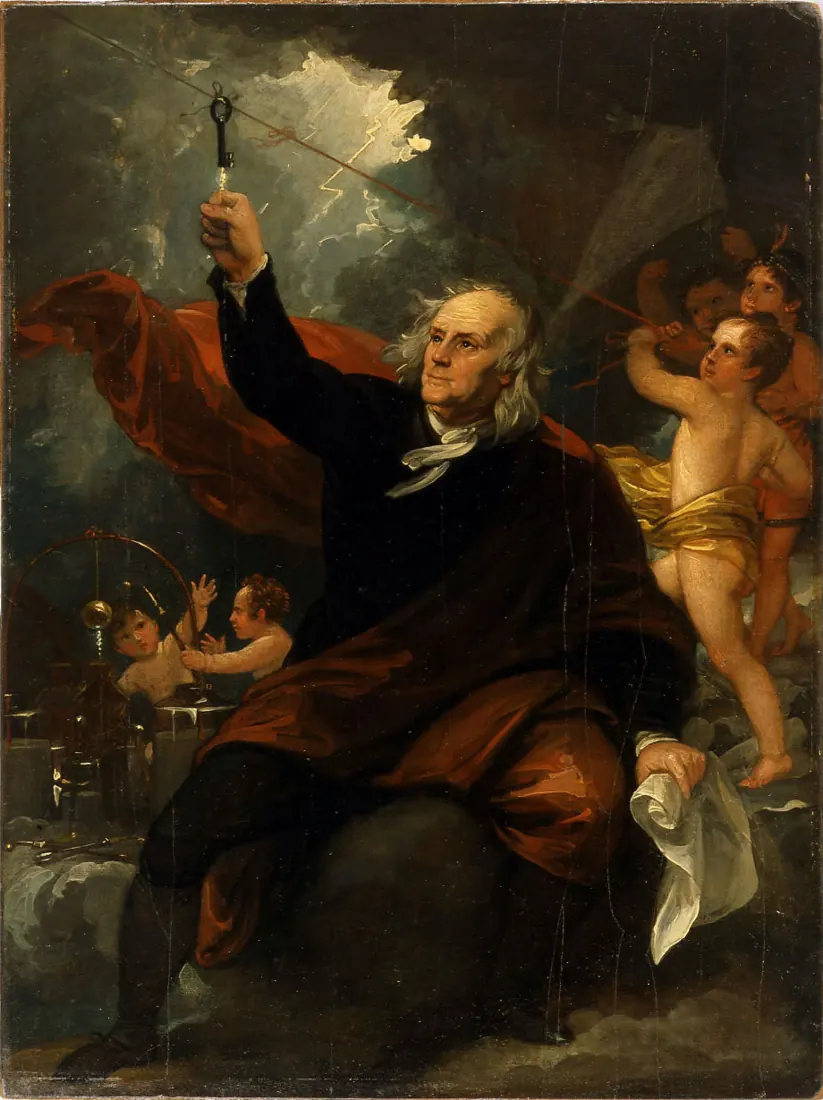
    Benjamin Franklin wanted to prove that lightning is electricity. The famous telling says that in June 1752, in Philadelphia, he and his son flew a silk kite in a storm, with a metal key tied to the string and a dry silk ribbon in his hand, and used the key to charge a Leyden jar (an early way to store charge). The kite was never struck by lightning; it picked up charge from the stormy air. Historians still debate the details, because Franklin’s own account (October 1752) is short, and the fuller story comes from Joseph Priestley, writing years later. What is certain: French experimenters had already proved the lightning idea with Franklin’s proposed tall metal rod in 1752, and his work led to the lightning rod.

    Neat fact Please never try this. A scientist named Georg Richmann was killed in 1753 while attempting a similar experiment.

    Painting of Benjamin Franklin seated in the clouds, drawing a spark from a key, with cherubs around him
    Benjamin West, “Benjamin Franklin Drawing Electricity from the Sky,” painted about 1816. An imaginative tribute made decades later, not a record of the day. Image: Benjamin West (c. 1816), Philadelphia Museum of Art · Public domain · source
    Link to this stop
  4. Volta builds the first battery

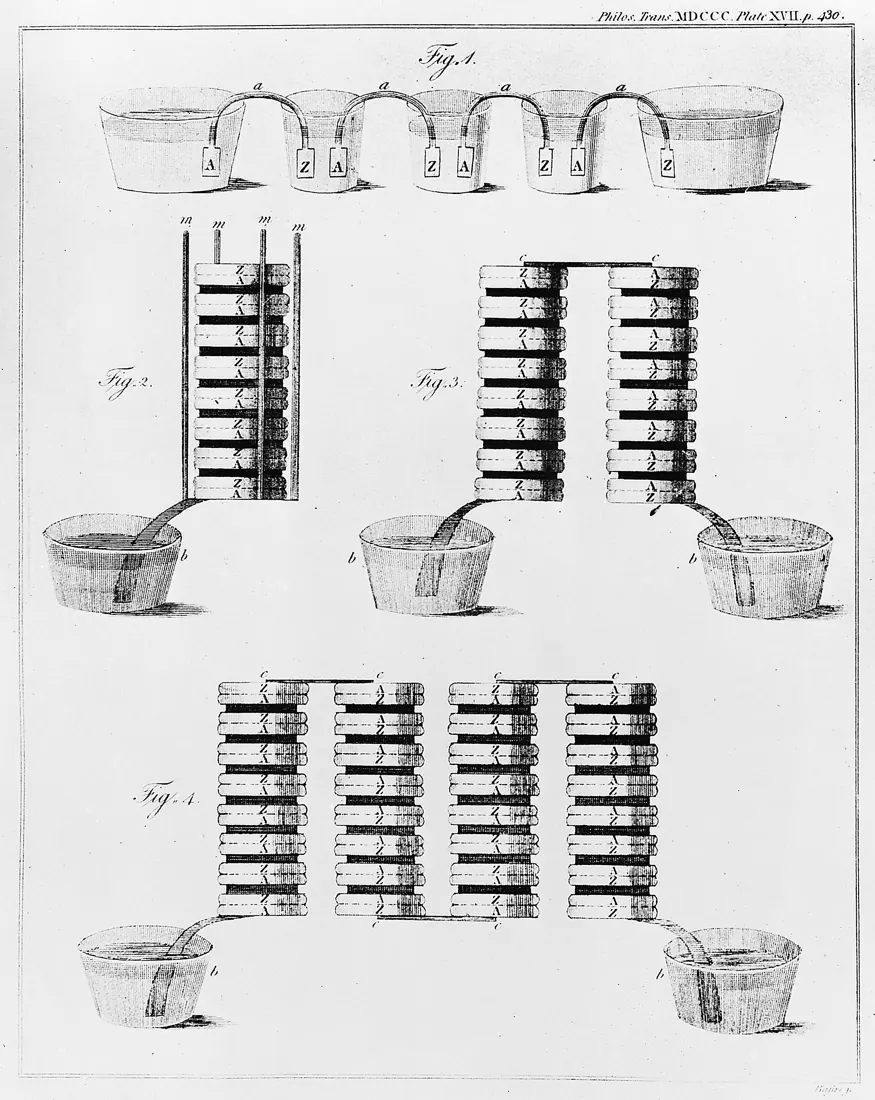
    Alessandro Volta stacked discs of zinc and copper with cloth soaked in salt water between them. The “pile” gave something new: a steady, continuous electric current instead of a single spark. He built it in 1799 and described it in a letter to the Royal Society of London dated March 20, 1800. Suddenly scientists everywhere could run experiments with current that kept flowing.

    Neat fact The volt, the unit printed on every outlet and battery, is named after him. Napoleon invited him to Paris to demonstrate the pile in 1801.

    Engraved plate showing stacked metal discs of Volta’s pile and a ring of cups joined by metal strips
    Volta’s own drawings of his pile and “crown of cups,” published with his 1800 letter to the Royal Society. Image: Wellcome Collection · CC BY 4.0 · source
    Diagram of Volta’s pileA stack of alternating zinc discs, copper discs and salt-water cloth, with a wire looping from the top of the stack to the bottom through a small lamp. Arrows show current flowing around the loop.ZincCopperSalt-waterclothLampcurrent flows
    How a voltaic pile works: zinc and copper discs, separated by cloth soaked in salt water, stacked up. Each zinc–copper pair adds a little push (voltage), and a wire from top to bottom carries a steady current. Diagram: IES
    Link to this stop
  5. Ørsted sees a compass needle jump

    During an evening lecture in April 1820, Hans Christian Ørsted noticed that a wire carrying current made a nearby compass needle swing. It was the first clear proof that electricity and magnetism are connected. That link is the basis of every motor, generator and transformer that came after.

    Neat fact The discovery happened in front of an audience, during a lecture.

    Link to this stop
  6. Ampère works out the rules

    When Ørsted’s result was shown in Paris later in 1820, André-Marie Ampère showed that two parallel wires carrying current pull together or push apart, depending on which way the current flows. He turned it into math, and in 1827 he published the work that named the new field “electrodynamics.”

    Neat fact The ampere (the “amps” on every breaker handle) was adopted as a unit in 1881 and named in his honor.

    Link to this stop
  7. Ohm explains resistance

    Georg Simon Ohm, a German schoolteacher, published a careful study in 1827 showing how current, voltage and resistance relate. Today we write it as Ohm’s law, and electricians use it every day. At first his work was coldly received, and he even left his teaching post over it. Recognition came later.

    Neat fact Britain’s Royal Society awarded Ohm its Copley Medal in 1841, 14 years after the book that was once brushed aside.

    Link to this stop
  8. Faraday makes electricity from magnetism

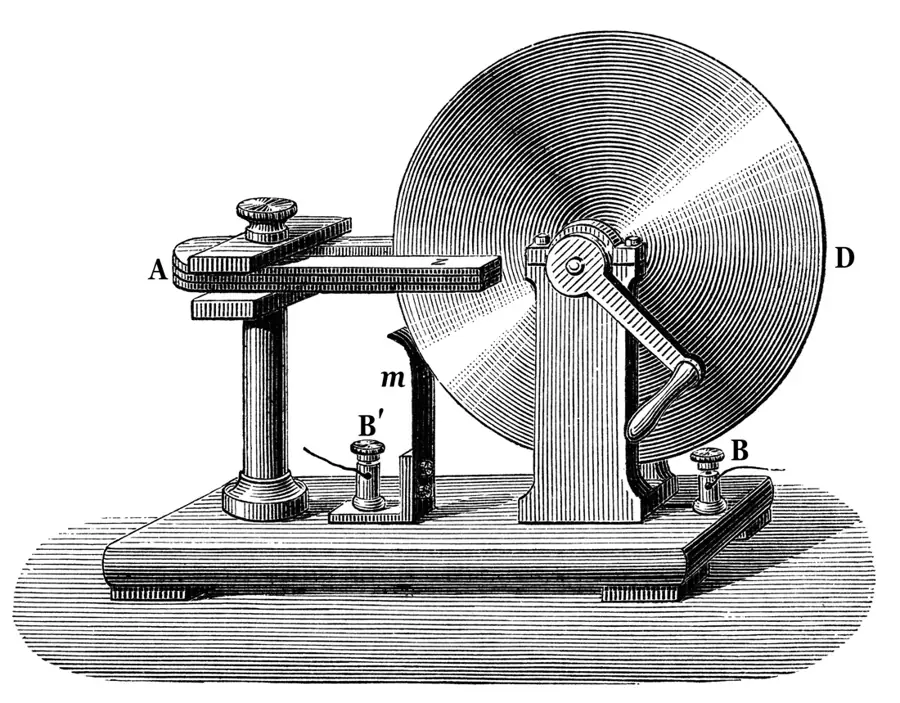
    Michael Faraday was a blacksmith’s son who started as a bookbinder’s apprentice and became Humphry Davy’s lab assistant. On August 29, 1831, using an iron ring wrapped with two coils of wire, he showed that a changing magnetic field makes current flow. That is electromagnetic induction. Later that fall he turned a copper disk between the poles of a magnet and got a steady current: the first generator (dynamo).

    Neat fact Almost every power plant that spins a generator, from a hydro dam to a backup generator at a house, relies on what Faraday showed in 1831.

    Engraving of a copper disk turning between the poles of a horseshoe magnet, with a hand crank
    Faraday’s disk generator, as drawn in an 1884 book on electric light. Image: Émile Alglave & J. Boulard, “The Electric Light” (1884) · Public domain · source
    Diagram of Faraday’s disk generatorA copper disk spins between the north and south poles of a horseshoe magnet. Sliding contacts touch the axle and the rim, and wires lead to a meter whose needle moves.NSturn itcopper diskmetermagnet
    Faraday’s disk: turn a copper disk between the poles of a magnet, and a steady current flows between the axle and the rim. Spin a conductor through a magnetic field and you get electricity. Every generator since works on that idea. Diagram: IES
    Link to this stop
  9. Telegraph & phone

    The telegraph: “What hath God wrought”

    Electricity’s first everyday job was carrying messages. A test line was strung between Washington and Baltimore, and on May 24, 1844, Samuel Morse tapped out a Bible verse from the U.S. Capitol to his partner Alfred Vail in Baltimore. Wires for messages spread long before wires for lights.

    Neat fact The message, from the Bible (Numbers 23:23), was suggested by Annie Ellsworth. The original paper tape is kept at the Library of Congress.

    Link to this stop
  10. Edison’s practical light bulb

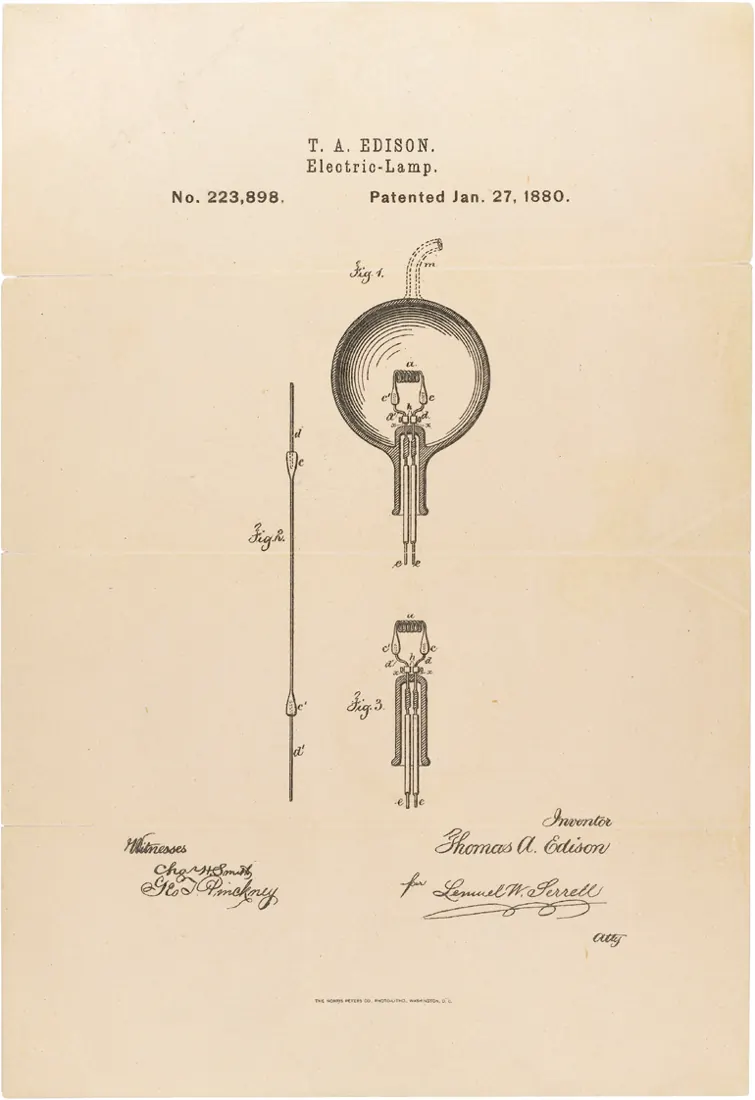
    Many inventors had made things glow with electricity; arc lamps were already lighting some streets. In October 1879, at Menlo Park, New Jersey, Thomas Edison’s team got a carbon-filament lamp in a glass vacuum bulb to work well enough to be practical, and he was granted the patent on January 27, 1880. Just as important, Edison set out to build the whole system around the bulb: generators, wiring and fuses.

    Neat fact In the patent, Edison lists things he tried as filaments: cotton and linen thread, wood splints, and coiled paper.

    Patent drawing of Edison’s electric lamp showing a coiled carbon filament inside a glass bulb
    Drawing from Edison’s electric lamp patent, granted January 27, 1880. Image: U.S. National Archives · Public domain · source
    Link to this stop
  11. Safety & code

    The first fuses: a wire that sacrifices itself

    Edison knew that too much current in a wire means heat and fire risk. His answer was a short, thin “safety wire” in the circuit that melts when the current gets dangerous, cutting off just that branch. His patent of May 4, 1880, puts the thin wire inside a non-conducting shell. Fuses were part of the Pearl Street system in 1882, and the same idea protected homes for decades.

    Neat fact The patent says the shell keeps drops of hot, melted metal from falling onto carpets or furniture.

    Link to this stop
  12. Pearl Street Station lights Manhattan

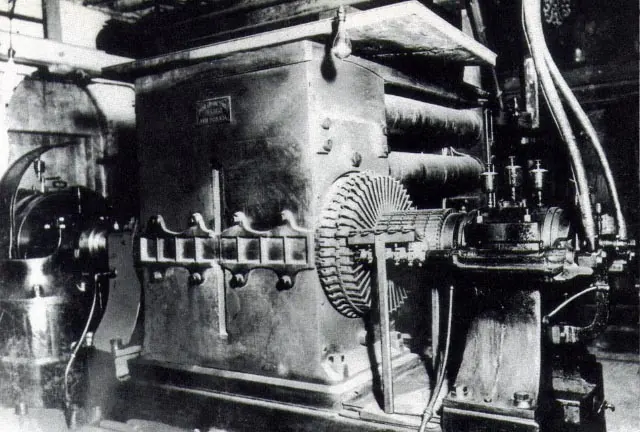
    Edison’s Pearl Street Station in lower Manhattan began serving customers on September 4, 1882, about a quarter square mile around it, with direct current (DC) at about 110 volts. Six huge steam-driven “Jumbo” dynamos did the work. It started with about 85 customers and about 400 lamps; within a year it served 513 customers. Edison was in J. P. Morgan’s office when the switch was thrown.

    Neat fact The Jumbo dynamos were nicknamed after P. T. Barnum’s famous circus elephant. Between opening day and a fire in January 1890, the station had just one outage, lasting about three hours.

    Old photograph of a large Jumbo dynamo with heavy iron magnets, coupled to a steam engine
    An Edison “Jumbo” dynamo at Pearl Street Station, photographed in the 1880s. Image: Unknown photographer, c. 1882–1890 · Public domain · source
    Link to this stop
  13. Stanley lights a Main Street with AC

    Edison’s DC had a big limit: it could not travel far without heavy losses, so stations had to sit close to customers. Alternating current (AC) could be stepped up to high voltage for travel and back down for use, with transformers. On March 20, 1886, William Stanley showed it working in Great Barrington, Massachusetts, stepping 500 volts up to 3,000 and back down to light about 20 businesses on Main Street.

    Neat fact Stanley strung his wires through the elm trees along Main Street.

    Link to this stop
  14. Tesla and Westinghouse team up on AC

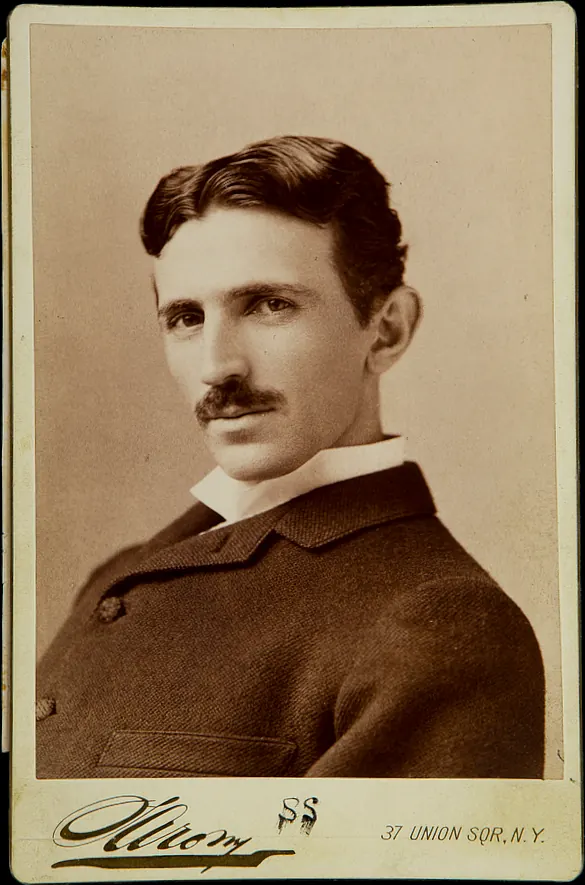
    Nikola Tesla arrived in America in 1884 and worked briefly for Edison before going his own way. He worked out how a rotating magnetic field could run a simple, rugged AC motor, and filed a stream of patents. In May 1888, George Westinghouse, already the inventor of the railroad air brake and an AC believer, bought the rights to Tesla’s AC system of generators, transformers and motors.

    Neat fact The tesla, a unit of magnetic field strength, was named for him in 1960.

    Studio portrait of Nikola Tesla as a young man with a mustache
    Nikola Tesla, photographed by Napoleon Sarony in the early 1890s. Image: Napoleon Sarony (c. 1890–1896) · Public domain · source
    Link to this stop
  15. AC versus DC: the “war of the currents”

    Edison’s companies backed direct current. Westinghouse, using Tesla’s and Stanley’s ideas, backed alternating current. DC flows one way at a steady push. AC flips direction many times a second, and that is what lets a transformer raise the voltage for long-distance lines and lower it again for homes. That advantage, plus Tesla’s motor, is why AC won the grid. DC never went away, though: batteries, solar panels and the electronics in your phone all run on it.

    Neat fact In 1892, Edison’s company merged with a rival to form General Electric, and the new company built AC equipment too.

    Direct current versus alternating currentTwo graphs of voltage over time. The DC graph is a flat line above zero. The AC graph is a smooth wave that rises above zero and falls below it, over and over.DCdirect current: one direction, steady0ACalternating current: flips back and forth0time →
    DC pushes one way at a steady level (top). AC swings back and forth; in the U.S. it completes 60 cycles every second (bottom). Because AC keeps changing, transformers can step its voltage up for long lines and back down for homes. Diagram: IES
    Link to this stop
  16. The Chicago World’s Fair glows with AC

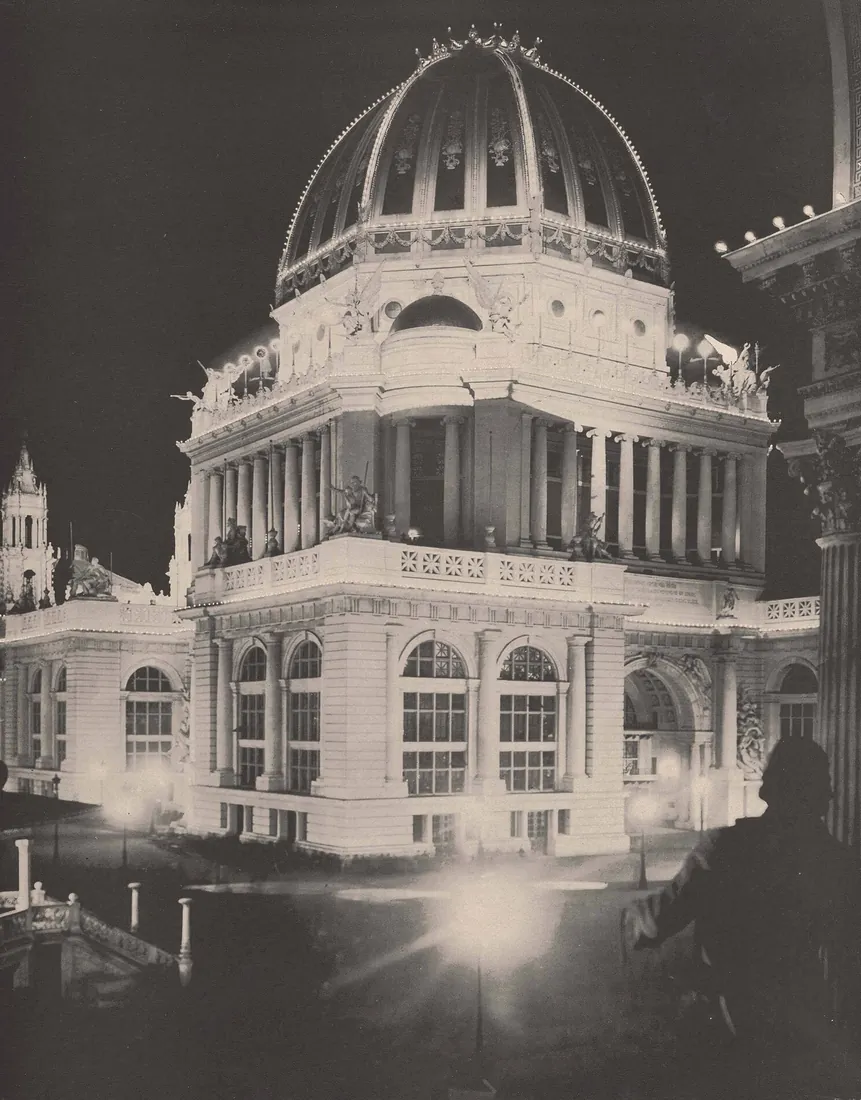
    Westinghouse won the contract to light the 1893 World’s Columbian Exposition in Chicago with an AC system, underbidding a DC proposal. More than 27 million visitors saw a city of lights, and the fair’s success helped Westinghouse win the work at Niagara Falls. The fair also needed someone to check all that wiring for fire risk, which leads to the next stop.

    Neat fact A patent fight meant Westinghouse could not use Edison-style bulbs, so his team rushed out a new “stopper lamp,” sealed with a ground glass stopper, just in time for the fair.

    Night photograph of a domed fair building outlined with electric lights, 1893
    The Administration Building lit up at night, photographed from the Electricity Building, Chicago, 1893. Image: William Henry Jackson (1893), via Ball State University · Public domain · source
    Link to this stop
  17. Safety & code

    A safety lab is born: UL

    William Henry Merrill had inspected electrical installations at the Chicago fair. In 1894 he set up a small testing lab in Chicago to check electrical products for fire risk. Its first test, on March 24, 1894, was of a non-combustible insulating material. The bureau was incorporated as Underwriters’ Laboratories in 1901, and the “UL” mark on cords and devices today traces back to that room.

    Neat fact The first lab started with about $350 worth of equipment, set up above a fire patrol station.

    Link to this stop
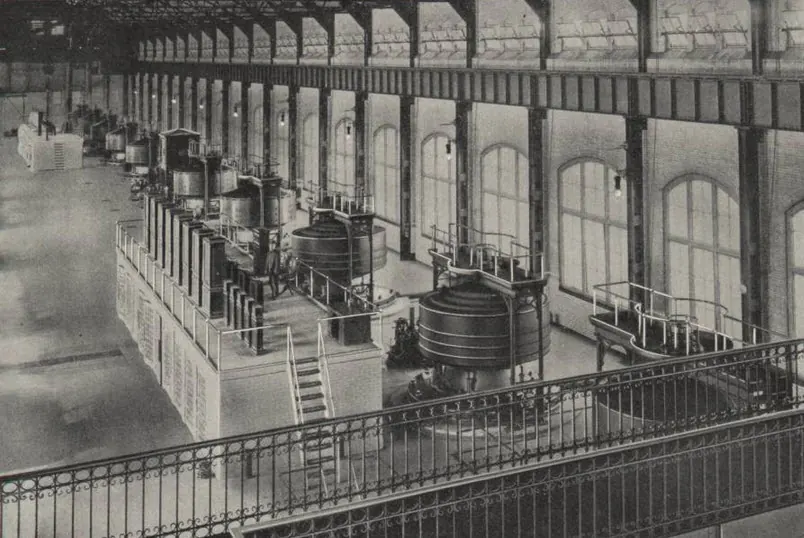
  18. Niagara Falls goes to work

    The Adams power plant at Niagara Falls began delivering AC power on August 26, 1895, first to nearby industries, using Westinghouse generators and Tesla’s system. In November 1896, the power reached Buffalo, more than 20 miles away, where it ran streetcars. Large-scale hydro plus long-distance AC lines was the pattern the rest of the country, including California, would follow.

    Neat fact Early protection was simple: in 1896 there was no switch that could safely interrupt a big short circuit on the line, so the system relied on lead and aluminum fuses.

    Long generator hall with a row of large round generators
    The Westinghouse generators in the Adams plant at Niagara Falls, from a 1904 company publication. Image: Westinghouse Electric & Manufacturing Co. (1904), via Library of Congress · Public domain · source
    Link to this stop
  19. Safety & code

    The first National Electrical Code

    By the end of 1895, the U.S. had five competing sets of electrical rules. In March 1896, a joint conference of electrical and allied groups met in New York to agree on one. The result, the first National Electrical Code, was published in 1897. The NFPA took it over in 1911, and it is still the NEC, NFPA 70, the rulebook that California builds its own Electrical Code on.

    Neat fact The 1897 code was published by the National Board of Fire Underwriters as Pamphlet No. 70. Today the code still carries the number 70: NFPA 70.

    Link to this stop
  20. Safety & code

    Knob-and-tube wiring in early homes

    Early houses were wired with single insulated copper wires held off the wood by porcelain knobs and passed through framing in porcelain tubes, with the hot and neutral run apart from each other. It was common in North America from about 1880 into the 1940s, and some older homes still have it. It has no ground wire, and its age, later DIY changes and insulation packed around it are what make it risky today.

    Neat fact The wires were spaced apart so they could shed heat into open air, which is why burying old knob-and-tube in insulation is a problem. If your home has it, have an electrician look it over.

    Link to this stop
  21. Safety & code

    The resettable breaker arrives

    Fuses work, but once one blows you have to replace it, and people sometimes bridged a blown fuse with a piece of wire, which is dangerous. In Germany, Hugo Stotz and his engineer Heinrich Schachtner patented a small automatic breaker on November 9, 1924. It combined a heat-sensing trip for overloads and a magnetic trip for short circuits, and could be reset with a button. Series production began in 1928.

    Neat fact The first models were shaped like a screw-in fuse and fit the same Edison-thread fuse sockets, so they could replace a fuse directly.

    Link to this stop
Era 2

California, the Sierra and PG&E

1879 – 1930

Closer to home. Gold Rush water know-how, early San Francisco lighting, the Folsom line, powerhouses in Nevada and Placer Counties, and how hundreds of small companies became one big utility.

  1. California

    San Francisco’s first central station

    In 1879, the newly formed California Electric Light Company built a small generating station at Fourth and Market Streets in San Francisco, using two steam-driven Brush generators to power arc lights. It made San Francisco the first city in California with a central station, and it is often credited as the first central station in the country to sell electric service to paying customers. Through mergers, it is one of the early roots of PG&E.

    Neat fact The “station” was a modest wood-framed shed covered in sheet iron. At the start it could run about 21 lights.

    Link to this stop
  2. California

    Mining water becomes electric light

    The Gold Rush left the Sierra with engineers who knew how to move water: ditches, flumes, tunnels and high-pressure pipes. As early as 1879, the Excelsior Water and Mining Company used a water-driven turbine to light three arc lamps at its mine. By 1896, Eugene de Sabla and partners had finished the “Rome” powerhouse in Nevada County, sending power to Nevada City and Grass Valley.

    Neat fact Those early mine lights ran on DC, which could only serve a short distance. Long lines had to wait for AC.

    Link to this stop
  3. California

    The Pelton wheel, born in Gold Country

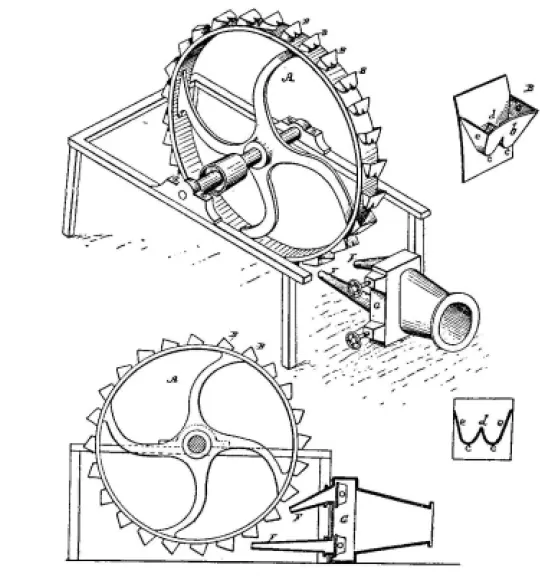
    Gold miners already used water wheels to run machinery. Lester Pelton built his first “splitter bucket” wheel at Camptonville in 1878, perfected it in Nevada City, and patented it in October 1880. A jet of water strikes cup-shaped buckets with a “splitter” down the middle. The design was simple to install and run, and it spread around the world.

    Neat fact The Pelton Waterwheel Collection in Grass Valley, at the old North Star power house, is an ASME engineering landmark you can visit.

    Patent drawing of a water wheel with split, cup-shaped buckets and a water nozzle
    Drawing from Lester Pelton’s October 1880 water wheel patent. Image: U.S. Patent Office (1880) · Public domain · source
    Link to this stop
  4. California

    Folsom to Sacramento: 22 miles of AC

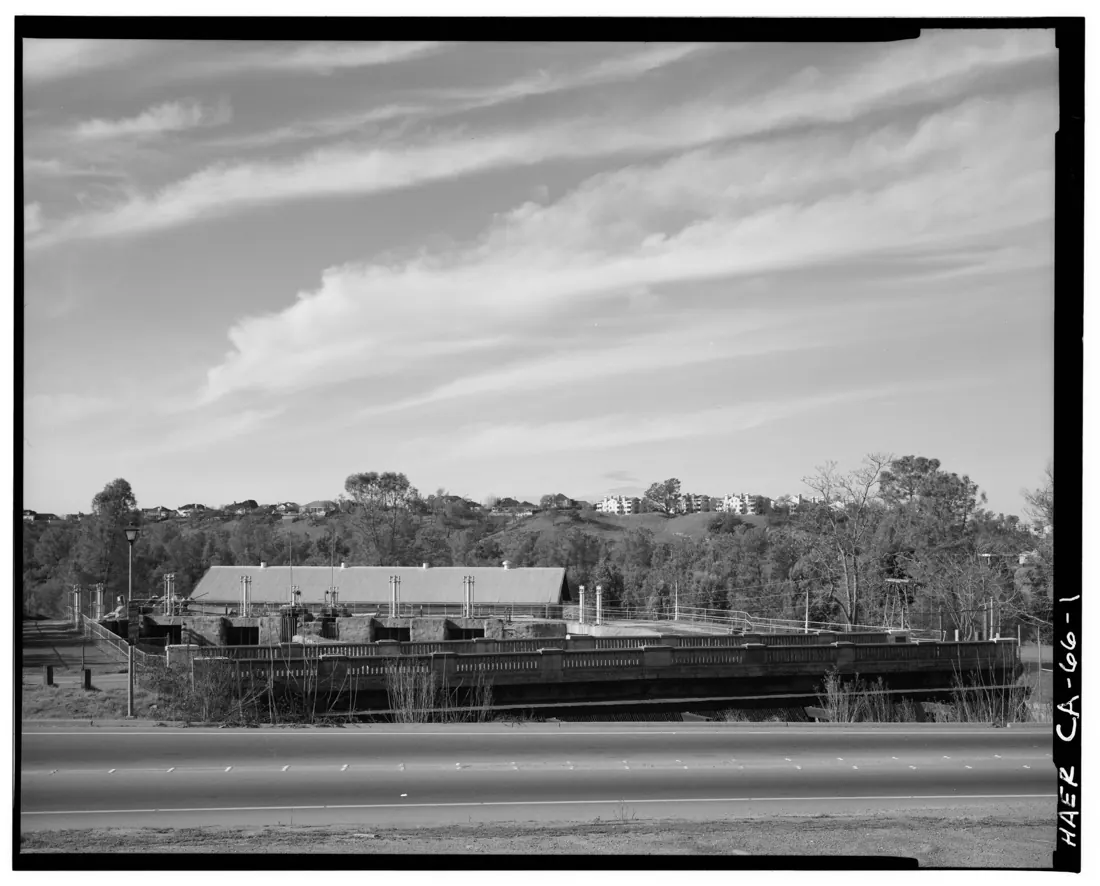
    On July 13, 1895, the Folsom Powerhouse on the American River began sending power 22 miles to Sacramento at 11,000 volts, using three-phase AC at 60 cycles, the same kind of power the grid uses today. That was a new achievement in long-distance, high-voltage transmission. (The first long-distance AC demonstration had taken place in Germany in 1891.) Sacramento celebrated with a grand electric carnival that September. The plant ran until 1952 and is now Folsom Powerhouse State Historic Park.

    Neat fact IEEE’s historians write that Folsom was, “with a high degree of confidence,” the first plant to make three-phase, 60-cycle AC, the kind that became the U.S. standard. The original generating plant is still in place.

    Black-and-white photo of the long, low stone Folsom Powerhouse and its forebay beside the American River
    Folsom Powerhouse, photographed in 1993 for the Historic American Engineering Record. Image: Brian Grogan, HAER (1993), Library of Congress · Public domain · source
    How power travels on a transmission lineFrom left to right: falling water turns a generator, a step-up transformer raises the voltage, wires run across several poles, and a step-down transformer lowers the voltage for houses in a city.GeneratorStep uphigh voltage, long distanceStep downCity
    The pattern Folsom helped prove: a hydro generator, a transformer that steps the voltage up (Folsom used 11,000 volts) for the long trip, high-voltage lines on poles, and a transformer that steps it back down in the city. Diagram: IES
    Link to this stop
  5. California

    Close to home: Newcastle, Auburn and Alta

    Right here in Placer County, early powerhouses went up at Newcastle (1896), Auburn (1898) and Alta (1902). By 1905 all three belonged to the South Yuba Water Company, fed by canals and reservoirs that stretched across Nevada and Placer Counties. California Gas and Electric bought the company in early 1905, months before the merger that formed PG&E.

    Neat fact The early-1905 purchase came with a 450-mile network of canals and diversions and 20 storage reservoirs. The state’s historic context study says the water rights were the most lasting part of the deal.

    Link to this stop
  6. California

    San Francisco’s light companies merge

    San Francisco’s early electric companies did not stay separate for long. In 1891, the California Electric Light Company and Edison’s local company combined into the Edison Light and Power Company. In 1896, that company joined with the San Francisco Gas Light Company to form San Francisco Gas and Electric, which owned the city’s gas works and steam-driven power plants.

    Neat fact The gas side of the family is even older: San Francisco’s first gas franchise dates to 1852, during the Gold Rush.

    Link to this stop
  7. California

    Colgate: Sierra power reaches the Bay

    In 1899, the Colgate Powerhouse on the Yuba River began sending power 61 miles to Sacramento at 22,000 volts. In 1901, its line was extended to Oakland, a record-breaking 142 miles, crossing the Carquinez Strait on the way. By 1903 it ran at a record-setting 60,000 volts. Sierra water was now lighting the Bay Area.

    Neat fact The line was celebrated for its AC engineering, and the crossing of the Carquinez Strait was one of its toughest challenges.

    Link to this stop
  8. California

    PG&E is formed

    San Francisco Gas and Electric had the big city market but no hydro plants. California Gas and Electric had Sierra hydro but needed the city. On October 10, 1905, they merged to form Pacific Gas and Electric Company, covering about 40,000 square miles of Northern California. John A. Britton became its first president. He had started as a laborer at the Oakland gas works, rose to bookkeeper, and studied electrical engineering at night school.

    Neat fact PG&E grew out of more than 500 earlier companies, from tiny mine plants to city gas works.

    Link to this stop
  9. California

    The 1906 earthquake and the rebuild

    Six months after the merger, the April 1906 earthquake and fire wrecked much of San Francisco. Gas mains broke, lines came down, and most of the new company’s city plants were badly damaged or destroyed. Rebuilding the city’s energy system became the young company’s first big job.

    Neat fact Only the Potrero Station A plant came through largely intact.

    Link to this stop
  10. California

    Drum–Spaulding: big hydro in the high country

    Starting in 1912, PG&E built the Drum–Spaulding project on South Yuba and Bear River water in the mountains of Nevada and Placer Counties. The 24,000-kilowatt Drum Powerhouse came online on November 26, 1913, linked by a 110,000-volt line that ran about 110 miles to Cordelia. Halsey (1916) and Wise (1917) powerhouses followed, and the system kept growing.

    Neat fact Spaulding No. 3 (1928) was the first partly automatic powerhouse in the PG&E system.

    Link to this stop
  11. California

    Rivals join, and a regional grid takes shape

    For years PG&E competed hard with other utilities, including Great Western Power, which brought Feather River power to the Bay Area, and San Joaquin Light and Power in the Central Valley. In 1930, PG&E bought both, and their plants and lines became part of one large Northern California system.

    Neat fact The rivalry with Great Western Power once turned into a long rate war, with Great Western slashing its rates to win PG&E customers.

    Link to this stop

Coming next

This timeline is a first chapter. We add more a little at a time, and only publish what we can check. Three new branches are ready now:

How we put this together

We are electricians, not historians, so we leaned on museums, libraries, engineering societies and the State of California’s historic preservation records, and we link them on every stop. We wrote everything in our own words. When sources disagree on a date or a “first,” we either say so or leave the claim out. Companies appear here only as part of history; IES is not affiliated with any of them. Spot something we got wrong? Let us know.

Image credits and licenses
  • Benjamin West, “Benjamin Franklin Drawing Electricity from the Sky,” painted about 1816. An imaginative tribute made decades later, not a record of the day. Benjamin West (c. 1816), Philadelphia Museum of Art. Public domain, via Wikimedia Commons.
  • Volta’s own drawings of his pile and “crown of cups,” published with his 1800 letter to the Royal Society. Wellcome Collection. CC BY 4.0, via Wikimedia Commons.
  • Faraday’s disk generator, as drawn in an 1884 book on electric light. Émile Alglave & J. Boulard, “The Electric Light” (1884). Public domain, via Wikimedia Commons.
  • Drawing from Edison’s electric lamp patent, granted January 27, 1880. U.S. National Archives. Public domain, via Wikimedia Commons.
  • An Edison “Jumbo” dynamo at Pearl Street Station, photographed in the 1880s. Unknown photographer, c. 1882–1890. Public domain, via Wikimedia Commons.
  • Nikola Tesla, photographed by Napoleon Sarony in the early 1890s. Napoleon Sarony (c. 1890–1896). Public domain, via Wikimedia Commons.
  • The Administration Building lit up at night, photographed from the Electricity Building, Chicago, 1893. William Henry Jackson (1893), via Ball State University. Public domain, via Wikimedia Commons.
  • The Westinghouse generators in the Adams plant at Niagara Falls, from a 1904 company publication. Westinghouse Electric & Manufacturing Co. (1904), via Library of Congress. Public domain, via Wikimedia Commons.
  • Drawing from Lester Pelton’s October 1880 water wheel patent. U.S. Patent Office (1880). Public domain, via Wikimedia Commons.
  • Folsom Powerhouse, photographed in 1993 for the Historic American Engineering Record. Brian Grogan, HAER (1993), Library of Congress. Public domain, via Wikimedia Commons.
  • Diagrams of the voltaic pile, Faraday’s disk, AC and DC, and the transmission line were drawn by IES for this page.
  • More photos, including the Great Eastern, are credited on the telegraph, cable and telephone page.