IES Learn · History · Telegraph, cable & telephone

From Telegraph to Fiber

How messages learned to cross land and sea, then started to talk: Morse’s telegraph, the Atlantic cables, Bell’s telephone, the rise, breakup and re-merging of the Bell System, and the copper, coax and glass in today’s walls. 37 stops, each with its sources.

This branch of The Story of Electricity follows electricity as a messenger. It starts before electric wires, crosses the Atlantic with the cable pioneers, then follows the telephone from Bell’s first words to the companies that run our phone lines today, and ends with the cables electricians pull through buildings now. Tap a stop to open it. Where accounts disagree, we say so.

  • 1851First undersea cable to last, England to France
  • 16½ hoursTo send Queen Victoria’s 98 words in 1858
  • 1866An Atlantic cable has worked ever since
  • 1876“Mr. Watson — come here”: the telephone
  • 1915First phone call across the continent, to San Francisco
  • Jan 1, 1984The Bell System splits into seven Baby Bells
  • 1988TAT-8: first fiber cable across an ocean
Part 1

Signals across the land

1794 – 1844

Before anyone could talk under an ocean, people had to learn to send words faster than a horse could run: first with signal towers, then with electric wires along the railways.

  1. Optical telegraph

    Chappe’s towers: a telegraph without electricity

    The first working “telegraph” used no wires at all. In France, Claude Chappe built a chain of towers on high ground between Paris and Lille. Each tower had a pair of telescopes and a two-armed signal (a semaphore) on top. Each arm could take seven positions, giving 49 signs for letters and symbols. Operators read the tower before them and copied its signal for the next one. In August 1794 the line brought Paris news of a battle at Condé-sur-l’Escaut in less than an hour.

    Neat fact Chappe coined the word “semaphore,” from Greek words meaning “bearing a sign.” Lines like his were copied across Europe.

    Link to this stop
  2. Forerunner

    A garden full of wire: early electric experiments

    Many people tried to send signals with electricity before it became practical. One well-documented try: in the summer of 1816, Francis Ronalds strung about eight miles of thin iron wire back and forth on frames in his garden in Hammersmith, west of London, and sent signals through it with static electricity. He also buried a wire in a glass-lined trough to test signalling underground. Static gives only a quick spark at a time, so it was a dead end, but the idea of “writing at a distance” was in the air.

    Neat fact The British telegraph history we rely on says a 15-year-old Charles Wheatstone was taken to see Ronalds’s garden telegraph in 1817. Twenty years later, Wheatstone co-patented the first practical British telegraph.

    Link to this stop
  3. Electric telegraph

    Cooke and Wheatstone wire the railways

    William Cooke, a businessman, and Charles Wheatstone, a London professor, received their British patent for an electric telegraph on June 10, 1837. Their instruments used magnetic needles that swung to point at letters on a board. The railways were the first customers. A line along the Great Western Railway, 13 miles from Paddington to West Drayton, was completed on July 9, 1839, for the railway’s own use. On May 16, 1843, the line, by then extended to Slough, opened to the public for paid messages: Britain’s first public telegraph service.

    Neat fact The Science Museum calls Cooke and Wheatstone’s system the world’s first practical telegraph. In their five-needle design, any two needles swing together to point at a letter.

    Link to this stop
  4. Electric telegraph

    Morse: “What hath God wrought”

    In America, Samuel Morse took a simpler approach: one circuit, a key that makes short and long pulses, and a code of dots and dashes. A test line was strung between Washington and Baltimore, and on May 24, 1844, Morse sent “What hath God wrought” from the U.S. Capitol to his partner Alfred Vail in Baltimore. Morse code, and the idea that one wire could carry any message, spread fast.

    Neat fact The Library of Congress keeps the original tape. The Smithsonian has a souvenir copy dated May 25, 1844, which Vail sent back to Morse the next day.

    Link to this stop
Part 2

Under the sea: the Atlantic cable

1850 – 1866

A short cable across the English Channel, then a twelve-year fight to cross the Atlantic: failed voyages, a famous message from Queen Victoria, a cable that died within weeks, an argument about why, and the giant ship that finally did it.

  1. Undersea cable

    The first cable under the sea works for about a day

    Brothers Jacob and John Watkins Brett had permission from France to join England and France by wire. On August 28, 1850, the tugboat Goliath paid out a single copper wire covered in gutta-percha (a natural, rubber-like latex from Southeast Asian trees) from Dover to Cap Gris-Nez. It had no armor, so lead weights were tied on to sink it. Signals got across, but the cable failed almost at once, worn through on rocks near the French shore.

    Neat fact A popular tale says a French fisherman hauled up the cable and cut off a piece, thinking it was a strange seaweed with gold in the middle. The Atlantic-Cable.com historians call this a myth that started in an 1865 book.

    Link to this stop
  2. Undersea cable

    1851: the first undersea cable that lasts

    The Bretts’ company tried again with a much tougher design: four copper wires, each insulated with gutta-percha, bundled with tarred yarn and wrapped in ten galvanized iron wires. It was laid from the old warship Blazer in late September 1851, from near Dover to Sangatte, near Calais. After a short extra length was spliced in, the line was fully working on October 17, 1851, and public messages followed that November. It was the first commercially successful undersea cable.

    Neat fact The 1851 design (a copper core, insulation, padding and an iron armor jacket) set the basic pattern for undersea cables for about a century.

    The 1850 and 1851 English Channel cables, cut openTwo circles side by side. The 1850 cable is a small copper dot inside a brown insulating ring. The 1851 cable is much larger: four copper wires, each in insulation, packed in tarred yarn, surrounded by a ring of ten thick iron wires.1850worked about a daycopper wirein gutta-percha,no armor1851: the one that lasted4 copper wires in gutta-perchatarred yarn packing · 10 iron armor wires
    Cross-sections, not to scale. Left: the 1850 cable was a single copper wire in gutta-percha with no armor. Right: the 1851 cable had four insulated copper wires, tarred yarn packing, and ten galvanized iron armor wires. That armor is what let it survive on the seabed. Diagram: IES
    Link to this stop
  3. Atlantic cable

    Cyrus Field takes on the Atlantic

    Cyrus Field, a New York businessman, took up the idea of a telegraph from Newfoundland to Ireland in 1854. He raised money in New York and, in 1856, in England. The U.S. and British navies lent ships. The first attempt began in August 1857 with the USS Niagara and HMS Agamemnon. The cable broke and was lost at sea, and the season ended in failure.

    Neat fact Field traveled to Britain many times in the twelve years between taking up the project in 1854 and success in 1866.

    Link to this stop
  4. Atlantic cable

    1858: the Atlantic is crossed

    After more failures in the early summer of 1858, the ships tried a new plan: meet in mid-ocean, splice the two halves of the cable together, then steam apart. Niagara and Agamemnon made the splice on July 29, 1858. Niagara headed west to Trinity Bay, Newfoundland, and Agamemnon east to Valentia, Ireland. Both ends were ashore by August 5, 1858. Field wired the news that the electrical signals through the whole cable were perfect.

    Neat fact Field’s telegram gave the distance from the telegraph house at Valentia to the one at Trinity Bay as 1,698 nautical miles, more than two-thirds of it in water over two miles deep.

    Cross-section of the 1858 Atlantic cableConcentric layers from the center out: a copper strand of seven wires, three layers of gutta-percha insulation, a layer of tarred hemp, and an outer ring of eighteen iron strands, each made of seven thin wires. Labels point to each layer.Copper strand7 wires: carries the signalGutta-percha, 3 coatsnatural latex insulationTarred hemppadding and beddingIron armor18 strands × 7 wiresNot to scale.
    The 1858 Atlantic cable, cut open (drawn larger than life, not to scale). At the center, a strand of seven copper wires carried the signal. Three coats of gutta-percha insulated it, tarred hemp padded it, and 18 strands of iron wire, each made of seven small wires, armored it. Diagram: IES
    Link to this stop
  5. Atlantic cable

    Queen Victoria’s message to President Buchanan

    Getting words through was slow work. On August 16, 1858, the first official message went from the company’s British directors to their American colleagues: “Europe and America are united by telegraph. Glory to God in the highest; on earth peace, good-will towards men.” That afternoon, Queen Victoria’s 98-word greeting to President James Buchanan began. It took about 16½ hours to send. Buchanan’s longer reply took about 10 hours. Before the cable, a message between London and Washington took perhaps twelve days by steamship and land telegraph.

    Neat fact The recorded tape of the Queen’s message is kept at Osborne House on the Isle of Wight.

    Link to this stop
  6. Atlantic cable

    The cable goes quiet, and an argument begins

    Within weeks the cable was failing. Effective messages stopped around September 1, 1858, and only a few scattered words got through after that. The company’s chief electrician, Wildman Whitehouse (a former surgeon), had used large induction coils that are estimated to have produced about 2,000 volts, trying to force a stronger signal through. The physicist William Thomson (later Lord Kelvin) took the opposite approach: small currents and his very sensitive mirror galvanometer, which read the faint signal as a tiny spot of light. The Queen’s message actually went through after Thomson’s instruments were put back. Whitehouse was dismissed.

    Neat fact A British government inquiry, the Joint Committee of 1859–61, took evidence on what went wrong. Whitehouse blamed manufacturing faults and strain on the cable; most accounts blame his high voltage at least in part. Modern writers note the cable probably had flaws from making and handling that would have doomed it anyway.

    Link to this stop
  7. Atlantic cable

    The Great Eastern, and a cable lost at sea

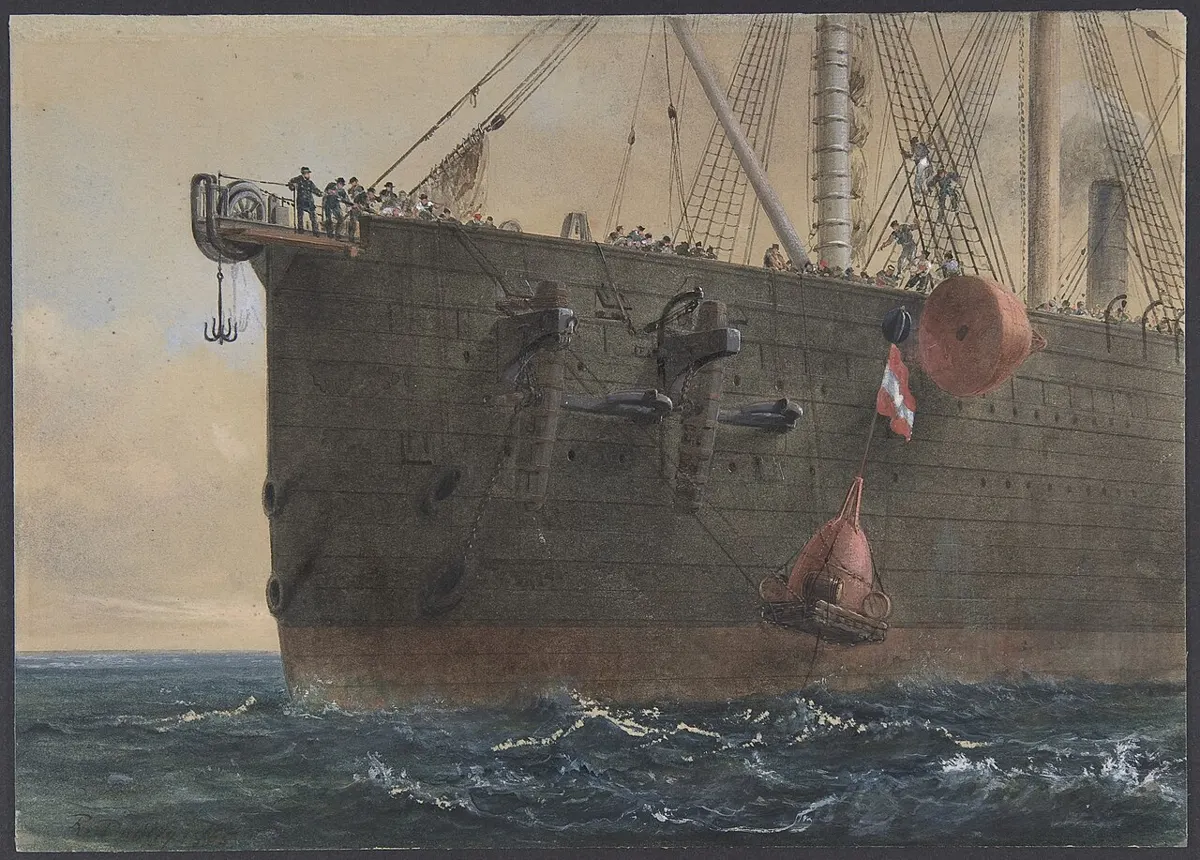
    It took until 1865 to try again. By then the company had a new, stronger cable and the giant steamship Great Eastern to lay it. She paid out cable westward from Ireland in July 1865. On August 2, 1865, the cable snapped and sank in mid-ocean. Several tries to hook it from the seabed failed, and the season ended.

    Neat fact During the 1865 voyage, broken flakes of the brittle armor wire pierced the insulation more than once. At first some suspected sabotage; the cause turned out to be the wire itself. The 1866 cable used softer, galvanized armor wire.

    Watercolor of the huge iron bow of the Great Eastern at sea, with men at the rail, a grappling hook hanging from the bow and a large buoy in the water
    Robert Dudley, “In the bows of the Great Eastern: the cable broken and lost, preparing to grapple, August 2nd, 1865.” Image: Robert Charles Dudley (1865), The Metropolitan Museum of Art · CC0 (public domain) · source
    Link to this stop
  8. Atlantic cable

    1866: a cable that stays working, and the lost one found

    The Great Eastern sailed west from Valentia on July 13, 1866, with a new cable, and the laying went smoothly. On July 27, 1866, she arrived at Heart’s Content, Newfoundland, and the cable was landed. Then she went back to sea. In early September, after weeks of grappling in mid-ocean, her crew lifted the lost 1865 cable from the seabed, spliced on new cable and finished it to Newfoundland. By the end of that summer, two working cables crossed the Atlantic.

    Neat fact Atlantic-Cable.com notes that since July 27, 1866, there has always been at least one working telecommunications cable under the Atlantic between Europe and North America.

    Simplified map of the Atlantic cable routesNewfoundland on the left and Ireland on the right, with the Atlantic between. A dashed line marks the 1858 cable with its mid-ocean splice. A solid glowing line marks the 1866 cable from Valentia to Heart’s Content. A marker shows where the 1865 cable was lost and later raised.NewfoundlandIrelandValentiaHeart’s ContentBull’s Arm (1858)1858: ships splice mid-ocean1865 cable lost (Aug 1865),raised and finished (Sept 1866)1866: Great Eastern, July 13–27Simplified, not to scale · Trinity Bay is on the east side of Newfoundland
    The Atlantic cables, simplified and not to scale. Every attempt started at Valentia Island in Ireland. The 1858 cable was spliced in mid-ocean and landed at Bull’s Arm in Trinity Bay, Newfoundland. The 1866 cable, and the 1865 cable after it was raised and finished, landed at Heart’s Content, also on Trinity Bay. Diagram: IES
    Link to this stop
Part 3

Across every ocean: voices, then light

1902 – today

Cables crossed the Pacific, then started carrying voices, then pulses of laser light in glass fiber. The route your video call takes today traces back to those first copper wires.

  1. Pacific cable

    The British Pacific cable: Canada to Australia and New Zealand

    The Pacific is far wider than the Atlantic, so it took longer. A government-backed cable, championed for years by the Canadian engineer Sandford Fleming, ran from Bamfield on Vancouver Island to Fanning Island, then to Fiji and Norfolk Island, and on to Australia and New Zealand. The last section, from Fiji to Fanning Island, was finished on October 31, 1902, and the first messages crossed on November 1.

    Neat fact The Bamfield–Fanning Island section was 3,459 nautical miles long. Historians count it among the longest telegraph cables ever laid.

    Link to this stop
  2. Pacific cable

    San Francisco to Manila, and a message around the world

    The American cable started on our own coast. On December 14, 1902, about 40,000 people watched its shore end land at Ocean Beach in San Francisco, near the Cliff House. The section to Honolulu opened for business around the turn of the new year. Then came Honolulu to Midway, Midway to Guam, and Guam to Manila. The final link was made on July 4, 1903, and that day President Theodore Roosevelt sent greetings to Governor William Taft in Manila.

    Neat fact The same night, Roosevelt sent a message around the world on the cable network, from Oyster Bay, New York, and back. Trade magazines of the time put the trip at roughly 10 to 12 minutes (accounts differ).

    Link to this stop
  3. Telephone cable

    TAT-1: the first telephone cable across the Atlantic

    Telegraph cables carried dots and dashes. A voice needs much more, and over a long cable it fades unless it is boosted along the way. TAT-1 solved that with underwater amplifiers called repeaters, built around vacuum tubes. It used two cables, one for each direction, between Oban, Scotland, and Clarenville, Newfoundland, each about 1,950 nautical miles long with 51 repeaters. It went into service on September 25, 1956, with 36 telephone circuits.

    Neat fact The vacuum tubes in TAT-1’s repeaters never failed in 22 years of service, from 1956 to 1978.

    Link to this stop
  4. Fiber cable

    TAT-8: light in glass crosses an ocean

    TAT-8 was the first fiber-optic cable to cross an ocean. Instead of electric current in copper, it carried pulses of laser light in hair-thin glass fibers. Built by a group led by AT&T, British Telecom and France Telecom, it ran 5,846 km along the seabed between North America and Europe and entered service on December 14, 1988. It could carry about 40,000 phone calls at once.

    Neat fact IEEE’s historians say TAT-8 carried ten times as much as the last copper cable across the Atlantic. A 1988 report it cites says science writer Isaac Asimov took part in the dedication.

    Capacity of transatlantic cables, 1858 to 1988A note that one 98-word message in 1858 took about 16 and a half hours, then three bars on a logarithmic scale: TAT-1 in 1956 with 36 circuits, the last copper cable with about one tenth of TAT-8, and TAT-8 in 1988 with about 40,000 calls.1858one 98-word message: about 16½ hoursTAT-1, 195636 circuitsLast copper cableabout ⅒ of TAT-8TAT-8, 1988about 40,000 callsBars on a logarithmic scale (each step is roughly ×10)Copper wire → vacuum-tube repeaters → laser light in glass fiber
    How much could cross at once. TAT-1 (1956) had 36 telephone circuits. TAT-8 (1988) could carry about 40,000 calls, which IEEE says was ten times the last copper cable. The bars use a stretched (logarithmic) scale; on a normal scale the TAT-1 bar would be a sliver. For contrast, in 1858 Queen Victoria’s 98-word message took about 16½ hours. Diagram: IES
    Link to this stop
  5. Undersea fiber

    Today: the internet still runs under the sea

    It is easy to think the internet travels by satellite, but almost all of it between continents goes through cables on the ocean floor, the great-grandchildren of the 1851 Channel cable. As of February 2025, the research firm TeleGeography counted about 570 submarine cable systems in service, with dozens more planned. When you stream a video from another continent, it most likely went through glass fibers on the seabed.

    Neat fact The often-repeated claim that cables carry “over 99%” of intercontinental traffic is one TeleGeography says it can confirm, though it notes an exact figure is hard to calculate without satellite data.

    Link to this stop
Part 4

Talking by wire: the telephone and the Bell System

1861 – today

The telegraph finally reached California. Then Bell’s telephone grew into one giant network, the Bell System, until a court settlement split it into pieces in 1984. Since then, most of those pieces have come back together.

  1. California

    The wire reaches California, and the Pony Express rides off

    Before late 1861, the fastest news between the East and California came by the Pony Express. Riders relayed mail between St. Joseph, Missouri, and Sacramento, where it went on to San Francisco by boat. On October 24, 1861, Western Union joined its eastern and western lines and completed the first telegraph across the continent. A message that had taken riders more than a week could now cross the country in moments. Two days later, on October 26, the Pony Express officially closed.

    Neat fact The Pony Express lasted only about 19 months, from April 1860. Its riders’ best time, carrying President Lincoln’s first inaugural address, was 7 days and 17 hours.

    Link to this stop
  2. Telephone

    “Mr. Watson, come here”: the telephone

    Alexander Graham Bell, then 29, was working on a “harmonic telegraph” that would send several messages down one wire at once using different pitches. With his assistant, Thomas Watson, he chased a bigger idea: sending the human voice. Bell’s patent, No. 174,465, was issued on March 7, 1876. Three days later, on March 10, his notebook records the experiment in which Watson heard him through the instrument: “Mr. Watson — come here — I want to see you.”

    Neat fact The famous story that Bell reached the patent office a few hours ahead of rival inventor Elisha Gray is true as far as it goes, but IEEE’s historians say it is not the whole story: priority then depended on the date of invention, not of filing. Court fights over Bell’s patents went on for eighteen years, and all were settled in his favor.

    Link to this stop
  3. Bell System

    From one patent to the Bell System

    In 1877 Bell and his two backers, Gardiner Hubbard and Thomas Sanders, formed the Bell Telephone Company. The first commercial switchboard opened in New Haven, Connecticut, in 1878. In 1882 the company, by then American Bell, bought control of the Western Electric Company, which became its equipment maker. On March 3, 1885, American Bell set up the American Telephone and Telegraph Company, AT&T, to build long-distance lines; they reached Chicago in 1892. On December 30, 1899, AT&T took over American Bell’s assets and became the parent of what came to be called the Bell System.

    Neat fact After Bell’s second patent expired in 1894, more than six thousand independent phone companies started up within ten years, and U.S. telephones went from about 285,000 to more than 3.3 million, according to AT&T’s own history.

    Link to this stop
  4. California

    California’s Bell company: Pacific Telephone & Telegraph

    On the West Coast the Bell business ran through its own regional company. San Francisco’s Pacific Telephone and Telegraph Company was reorganized as Pacific States Telephone and Telegraph in 1900 and went by Pacific Telephone and Telegraph again from 1907, running the Bell System’s West Coast operations. Pacific Bell traces its incorporation in California to 1906, the year the earthquake and fire destroyed its downtown San Francisco telephone buildings. By 1915, AT&T’s Pacific Telephone subsidiary had built the western network the first coast-to-coast line would join.

    Neat fact Pacific Bell’s 1998 annual report still listed 1906 as its year of incorporation in California, with its offices at 140 New Montgomery Street in San Francisco.

    Link to this stop
  5. Long distance

    The first call across the continent

    Voices fade over long wires, so a phone line all the way to the Pacific needed help along the way: loading coils, and from 1913 the first practical electronic amplifiers, vacuum-tube repeaters developed at AT&T. The line was tested in 1914, and the official opening came on January 25, 1915, in time for San Francisco’s Panama-Pacific Exposition. Bell, in New York, spoke to Watson, in San Francisco. President Woodrow Wilson and AT&T’s president, Theodore Vail, joined the call from elsewhere.

    Neat fact Bell repeated his request from 1876, asking Watson to come to him. Watson answered that this time it would take him a week. (Accounts of the exact words differ a little.)

    Link to this stop
  6. Research

    Bell Labs opens

    By 1924 the engineering staff of AT&T and Western Electric had grown to more than 3,600 people. The two companies made it a separate research company, owned jointly: Bell Telephone Laboratories began work on January 1, 1925, in New York City. Bell Labs grew into one of the largest industrial research labs in the world, and several stops on this page came out of it.

    Neat fact In 1947 an AT&T researcher, Douglas Ring, sketched the idea of a cellular network: a city split into small “cells,” with calls handed from one to the next. The electronics to build it did not exist yet. Commercial service took 36 more years.

    Link to this stop
  7. Transistor

    The transistor

    At Bell Labs in New Jersey, between November 17 and December 23, 1947, Walter Brattain and John Bardeen, working under William Shockley, discovered the transistor effect and built the first working transistor, a point-contact device made with germanium. Like a vacuum tube, it could amplify a signal, but it was a small solid part. IEEE’s milestone plaque says it led directly to the solid-state devices that changed the electronics industry, and it is the ancestor of the chips in every phone and network switch.

    Neat fact Shockley, Bardeen and Brattain shared the 1956 Nobel Prize in Physics for the work.

    Link to this stop
  8. Cell phone

    The first handheld cell phone call

    On Sixth Avenue in New York, Motorola’s Martin Cooper made the first public call from a handheld cellular phone, a prototype of what became the DynaTAC. He called Joel Engel, who led AT&T’s rival cellular program, to tell him he was calling from a real handheld portable phone.

    Neat fact Phones you could take in a car had existed for years, but by the 1960s they still weighed 30 to 40 pounds and were mounted in the trunk.

    Link to this stop
  9. Cellular

    Cell service goes on sale: AMPS in Chicago

    Commercial cellular service in the U.S. began in Chicago on October 13, 1983. It used AMPS (Advanced Mobile Phone Service), the analog cellular system developed at Bell Labs and tested in Chicago from 1978. The area was divided into cells, each with its own low-power radio site, and calls were handed from cell to cell as people drove. AT&T’s history credits AT&T together with Ameritech, the Midwest Bell group about to be spun off; news reports at the time named Ameritech Mobile Communications. This was the first generation, or “1G,” of cell service.

    Neat fact The launch was marked with a news conference at Soldier Field, according to a UPI report the next day.

    Link to this stop
  10. Breakup

    The Bell System is broken up

    In 1974 the U.S. Justice Department sued AT&T under antitrust law. On January 8, 1982, the two sides settled: AT&T would give up its local phone companies and keep long distance, Western Electric manufacturing and Bell Labs. Judge Harold Greene approved the settlement on August 24, 1982. On January 1, 1984, the 22 local Bell companies went to seven new regional companies, nicknamed the “Baby Bells”: Ameritech, Bell Atlantic, BellSouth, NYNEX, Pacific Telesis, Southwestern Bell and U S West. The Bell System, as one company, was gone.

    Neat fact Each Baby Bell held several of the old phone companies. NYNEX, for example, held New York Telephone and New England Telephone; U S West held Mountain Bell, Northwestern Bell and Pacific Northwest Bell.

    Link to this stop
  11. California

    California’s Baby Bell: Pacific Telesis

    In the breakup, California’s phone company went to Pacific Telesis Group, which held Pacific Bell, California’s Bell company, and Nevada Bell. It was spun off from AT&T to shareholders on January 1, 1984, as an independent company. On April 1, 1997, SBC Communications, the former Southwestern Bell, bought it. Pacific Bell is now part of AT&T Inc.

    Neat fact Pacific Telesis was the first of the seven Baby Bells to be bought: SBC closed the deal in April 1997, a few months before Bell Atlantic and NYNEX combined.

    Link to this stop
  12. Re-merging

    The Bells come back together

    Within about twenty years, the seven Baby Bells had folded into three companies. Southwestern Bell’s parent became SBC Communications in 1995 and bought Pacific Telesis (1997), Southern New England Telecommunications (1998) and Ameritech (1999). On November 18, 2005, SBC bought AT&T Corp., the long-distance company left after the breakup, and took the name AT&T Inc.; it added BellSouth on December 29, 2006. In the East, Bell Atlantic combined with NYNEX in 1997 and with GTE, a large non-Bell phone company, on June 30, 2000, forming Verizon. In the West, Qwest took over U S West in 2000; CenturyLink bought Qwest in 2011 and renamed itself Lumen in 2020.

    Neat fact Today’s AT&T Inc. is not the same company that was broken up in 1984. It is the former Southwestern Bell, one of the Baby Bells, which bought its old parent and took its name.

    Link to this stop

The Baby Bells family tree

How to read it: the Bell System line stops on January 1, 1984. Each line after that is one of the companies that started that day (or a non-Bell company that joined later). Where a line curves into another, it was bought or merged; diamonds mark name changes. Tap a name for its story, or press Play to watch the Bells come back together.

The Baby Bells family tree, 1984 to todayThe Bell System line ends on January 1, 1984. Seven regional companies and the long-distance AT&T start that day. Lines curve into the company that bought them, at the year it happened. Diamonds mark name changes. Lanes group the companies by where they ended up. The same information is in the list below the chart.BEFORE 1984The Bell System as onecompany ended January 1,1984.AT&T INC. · where these companies are todayAT&T Inc., the formerSBC CommunicationsVERIZON · where these companies are todayVerizon CommunicationsLUMEN · where these companies are todayLumen Technologies, theformer CenturyLinkBroken up January 1, 1984SBCAT&T Inc.VerizonCenturyLinkLumenThe Bell System1877–1983Southwestern Bell / SBC1984Pacific Telesis1984Ameritech1984AT&T Corp.1984BellSouth1984Bell Atlantic1984NYNEX1984GTE1918 rootsCenturyTel / CenturyLink1930 rootsQwest1988U S West19842026
CompanyBought or mergedName changeEndedSwipe sideways to see the whole tree →

Every company, in words

The same tree as a list, grouped by where each company ended up. Each entry lists its sources.

Before 1984

Today: The Bell System as one company ended January 1, 1984.

Sources: Congressional Research Service: The AT&T divestiture, background, provisions and restructuring (1984) AT&T: Milestones in AT&T history (archived AT&T corporate history page)

  1. The Bell System (AT&T) 1877–1983

    Beginnings
    Bell’s 1877 company grew into AT&T’s Bell System: long-distance lines, 22 local Bell telephone companies, Western Electric (equipment) and Bell Labs (research).
    Where it is today
    Split up. AT&T Corp. kept long distance, manufacturing and research; the local companies went to seven new regional companies.
    1. 1877 Bell Telephone Company formed.
    2. March 3, 1885 AT&T incorporated to build long-distance lines.
    3. 1899 AT&T becomes the parent company.
    4. 1974 The Justice Department files an antitrust suit.
    5. January 8, 1982 The suit is settled.
    6. August 24, 1982 Judge Harold Greene approves the settlement.
    7. January 1, 1984 The local companies go to seven new regional companies.

    Sources: AT&T: A brief history, origins (archived AT&T corporate history page) AT&T: Milestones in AT&T history (archived AT&T corporate history page) Congressional Research Service: The AT&T divestiture, background, provisions and restructuring (1984)

AT&T Inc.

Today: AT&T Inc., the former SBC Communications

Sources: FCC (ARMIS): Corporate history of AT&T Inc. and its Bell companies AT&T Inc.: annual report on Form 10-K for 2005 (SEC EDGAR)

  1. Southwestern Bell / SBC (now AT&T Inc.) 1984

    Beginnings
    One of the seven Baby Bells, built around Southwestern Bell Telephone.
    Where it is today
    AT&T Inc. It bought its old parent in 2005 and took the AT&T name.
    1. January 1, 1984 Starts as one of the seven Baby Bells.
    2. 1995 Parent company named SBC Communications.
    3. April 1, 1997 Buys Pacific Telesis.
    4. October 26, 1998 Buys Southern New England Telecommunications (SNET).
    5. October 8, 1999 Buys Ameritech.
    6. November 18, 2005 Buys AT&T Corp. and changes its name to AT&T Inc.
    7. December 29, 2006 Buys BellSouth.

    Sources: FCC (ARMIS): Corporate history of AT&T Inc. and its Bell companies AT&T Inc.: annual report on Form 10-K for 2005 (SEC EDGAR)

  2. Pacific Telesis (Pacific Bell, Nevada Bell) 1984

    Beginnings
    California’s Baby Bell. It held Pacific Bell, the Bell company for California, and Nevada Bell.
    Where it is today
    Part of AT&T Inc., since SBC bought it in 1997.
    1. January 1, 1984 Spun off from AT&T as an independent company.
    2. April 1, 1997 Bought by SBC Communications.

    Sources: Pacific Bell: annual report on Form 10-K for 1998 (SEC EDGAR) Congressional Research Service: The AT&T divestiture, background, provisions and restructuring (1984) FCC (ARMIS): Corporate history of AT&T Inc. and its Bell companies

  3. Ameritech 1984

    Beginnings
    The Midwest Baby Bell: Illinois Bell, Indiana Bell, Michigan Bell, Ohio Bell and Wisconsin Bell.
    Where it is today
    Part of AT&T Inc., since SBC bought it in 1999.
    1. October 13, 1983 Its cellular company opens commercial cell service in Chicago (AT&T’s history credits AT&T and Ameritech together).
    2. January 1, 1984 Starts as one of the seven Baby Bells.
    3. October 8, 1999 Bought by SBC Communications.

    Sources: Congressional Research Service: The AT&T divestiture, background, provisions and restructuring (1984) UPI Archives: Cellular mobile telephones introduced in Chicago (October 14, 1983) AT&T: Milestones in AT&T history (archived AT&T corporate history page) FCC (ARMIS): Corporate history of AT&T Inc. and its Bell companies

  4. AT&T Corp. (long distance) 1984

    Beginnings
    What remained of the old AT&T after the breakup: long distance, Western Electric manufacturing and Bell Labs.
    Where it is today
    Bought by SBC in 2005; SBC then took the AT&T name.
    1. January 1, 1984 Keeps long distance, manufacturing and research.
    2. November 18, 2005 Bought by SBC Communications.

    Sources: AT&T: Milestones in AT&T history (archived AT&T corporate history page) AT&T Inc.: annual report on Form 10-K for 2005 (SEC EDGAR)

  5. BellSouth 1984

    Beginnings
    The Baby Bell for the Southeast.
    Where it is today
    Part of AT&T Inc., since December 2006.
    1. January 1, 1984 Starts as one of the seven Baby Bells.
    2. December 29, 2006 Bought by AT&T Inc.

    Sources: Congressional Research Service: The AT&T divestiture, background, provisions and restructuring (1984) FCC (ARMIS): Corporate history of AT&T Inc. and its Bell companies

Verizon

Today: Verizon Communications

Source: Verizon: corporate history (PDF)

  1. Bell Atlantic (now Verizon) 1984

    Beginnings
    The Mid-Atlantic Baby Bell, based in Philadelphia: Bell of Pennsylvania, the C&P Telephone companies, Diamond State Telephone and New Jersey Bell.
    Where it is today
    Verizon Communications
    1. January 1, 1984 Starts as one of the seven Baby Bells.
    2. August 15, 1997 Combined with NYNEX, the “new” Bell Atlantic opens for business.
    3. April 3, 2000 The Verizon brand is launched.
    4. June 30, 2000 Merges with GTE; the company becomes Verizon Communications.

    Source: Verizon: corporate history (PDF)

  2. NYNEX 1984

    Beginnings
    The Baby Bell for New York and New England: New York Telephone and New England Telephone.
    Where it is today
    Part of Verizon, through its 1997 merger with Bell Atlantic.
    1. January 1, 1984 Starts as one of the seven Baby Bells.
    2. August 1997 Merges with Bell Atlantic.

    Verizon’s history says “NY” stood for New York, “NE” for New England and the “X” for the undefined future.

    Sources: Verizon: corporate history (PDF) Congressional Research Service: The AT&T divestiture, background, provisions and restructuring (1984)

  3. GTE (not a Bell company) 1918 roots

    Beginnings
    Began in 1918, when three partners bought the small Richland Telephone Company in Wisconsin. Became General Telephone & Electronics (GTE) after merging with Sylvania in 1959.
    Where it is today
    Part of Verizon since 2000.
    1. 1918 Roots in the Richland Telephone Company, Wisconsin.
    2. 1959 Merger with Sylvania forms General Telephone & Electronics.
    3. June 30, 2000 Merges with Bell Atlantic to form Verizon.

    Source: Verizon: corporate history (PDF)

Lumen

Today: Lumen Technologies, the former CenturyLink

Sources: Bell System Memorial: CenturyLink history Lumen investor relations: CenturyLink and Qwest complete merger (2011) Lumen investor relations: CenturyLink transforms, rebrands as Lumen (September 14, 2020)

  1. Qwest 1988

    Beginnings
    Began in 1988 as Southern Pacific Telecom, set up to lay telecommunications cable. Took the Qwest name in 1995.
    Where it is today
    Part of Lumen, since CenturyLink bought it in 2011.
    1. 1988 Southern Pacific Telecom is set up to lay cable.
    2. 1995 Renamed Qwest Communications.
    3. June 2000 Merges with U S West.
    4. 2011 Bought by CenturyLink.

    Sources: Bell System Memorial: CenturyLink history Lumen investor relations: CenturyLink and Qwest complete merger (2011)

  2. U S West 1984

    Beginnings
    The Baby Bell holding Mountain Bell, Northwestern Bell and Pacific Northwest Bell.
    Where it is today
    Part of Lumen, through Qwest.
    1. January 1, 1984 Starts as one of the seven Baby Bells.
    2. June 2000 Taken over by Qwest.

    Sources: Congressional Research Service: The AT&T divestiture, background, provisions and restructuring (1984) Bell System Memorial: CenturyLink history

Part 5

The wires in your walls

1881 – today

The same story that crossed oceans also came indoors. These are the leaps behind the low-voltage cabling electricians install today: copper pairs, coax, glass fiber, Ethernet, a common cabling standard, Wi-Fi and power over the data cable.

  1. Twisted pair

    Twisted pair: Bell’s answer to noise

    Early phone lines picked up interference from nearby wires. On July 19, 1881, Bell was granted patent 244,426 for a telephone circuit with two insulated wires for each line. The wires could lie side by side or be twisted, and his patent says the twisted ones were preferred because they gave the best freedom from “inductive disturbance.” Twisting puts any outside noise on both wires almost equally, so it largely cancels out at the far end. Network cable today, such as Cat 6, is still built from twisted pairs.

    Neat fact Bell’s patent also admits the twisted wires were “more liable to become injured by handling.” Installers still treat network cable gently for the same reason.

    Twisted pair, coaxial cable and optical fiber comparedThree columns. Left: a twisted-pair cable end, two colored insulated copper wires in a jacket, and a side view of the two wires twisting around each other. Middle: a coaxial cable end, a copper center wire, white insulation, a braided metal shield and a jacket, with a stepped cutaway side view. Right: an optical fiber end, a small glowing glass core inside glass cladding and a coating, with a side view of light bouncing along the core.Twisted pairCoaxFiberNoise hits both wiresabout equally, andlargely cancels outPhone lines, Cat 5e/6 dataCenter wire, insulation,metal shield, jacket:the shield keeps noise outCable TV, cameras, early EthernetGlass core and cladding:light stays in the core,no electric current at allBackbones, long runs, undersea
    Three kinds of cable, cut open (not to scale). Twisted pair: two insulated copper wires twisted together, so outside noise lands on both and largely cancels. Coax: a center wire, insulation, then a metal shield all the way around. Fiber: a hair-thin glass core inside glass cladding; light stays in the core and carries the signal. Diagram: IES
    Link to this stop
  2. Coax

    Coaxial cable

    At Bell Labs in 1929, Lloyd Espenschied and Herman Affel invented coaxial cable: one conductor in the center of a tube-shaped outer conductor, kept apart by insulation (air, in their design). The outer conductor holds the signal in and keeps outside interference out, and coax can carry a much wider range of frequencies than a simple pair. That let one cable carry thousands of phone calls at once, and later, with microwave relays, television signals across the country. Their patent was filed in 1929 and granted in 1931.

    Neat fact The first Ethernet, built at Xerox PARC in 1973, ran over a single shared coaxial cable.

    Link to this stop
  3. Fiber

    Low-loss glass fiber

    Light can carry far more information than electric current, but in the 1960s even good glass lost almost all of its light within a short distance: around 1,000 dB per kilometer. Researchers set a goal of 20 dB per kilometer as the point where fiber would be practical for phone lines. At Corning Glass Works, Robert Maurer, Donald Keck and Peter Schultz worked with very pure fused silica, and in August 1970 Keck measured a new fiber at about 16 to 17 dB per kilometer, beating the goal.

    Neat fact Keck’s notebook entry that day ended with one word: “Whoopee!” Eighteen years later, glass fiber carried calls across the Atlantic on TAT-8.

    Link to this stop
  4. Ethernet

    Ethernet

    At Xerox’s Palo Alto Research Center (PARC) in California, Bob Metcalfe and David Boggs built the first Ethernet in 1973 to connect the lab’s Alto computers and laser printers. It was inspired by ALOHAnet, a packet radio network at the University of Hawaii, and by the ARPANET. In 1980 Xerox, DEC and Intel published a 10-megabit Ethernet specification over coax, which became the IEEE 802.3 standard in 1985. Later versions moved to twisted pair and fiber.

    Neat fact Metcalfe’s idea was to capture ALOHAnet’s wireless “ether” inside a coaxial cable, with no central control. The “ether” in the name echoes that idea.

    Link to this stop
  5. Cabling standard

    TIA-568: one standard for building cabling

    Work on a common standard for wiring commercial buildings began in 1985, and in 1991 the industry published ANSI/EIA/TIA-568, the Commercial Building Telecommunications Wiring Standard. It set out “structured cabling”: standard cable types and distances, how cables end at jacks and panels, and how they are tested, no matter whose equipment is plugged in. Bulletins in 1991 and 1992 soon added specifications for unshielded twisted-pair cable and connectors.

    Neat fact An industry magazine looking back said the first edition took six years of meetings, debates and ballots. The standard has been revised many times since.

    Link to this stop
  6. Wi-Fi

    Wireless networks get a standard, then a name

    In June 1997 the IEEE approved 802.11, the first standard for wireless local networks, at 1 or 2 megabits per second. Faster versions followed, but buyers needed a simple name and proof that products from different makers would work together. In 1999 a group of companies formed the Wireless Ethernet Compatibility Alliance to test and certify them, and the Wi-Fi name dates from about then. In 2000 the group adopted “Wi-Fi” as the name for its work and became the Wi-Fi Alliance.

    Neat fact Despite a popular belief, “Wi-Fi” is not short for “wireless fidelity.” People involved say it was chosen as a brand name with no particular meaning.

    Link to this stop
  7. PoE

    Power over Ethernet

    On June 12, 2003, the IEEE approved 802.3af, the first standard for Power over Ethernet (PoE). It lets a network switch send low-voltage DC power down the same twisted-pair cable that carries data, up to 15.4 watts at the switch port. A phone, camera or wireless access point could now run on one cable, with no outlet nearby.

    Neat fact The project was approved in January 2000, so the standard took about three and a half years to finish.

    Link to this stop
  8. Cellular

    1G to 5G: cell phones by generation

    Each “G” is a new generation of cellular technology. 1G was analog voice, like AMPS in Chicago in 1983. 2G went digital: the first official GSM call was made in Finland on July 1, 1991. 3G brought faster mobile data; NTT DOCOMO in Japan launched its 3G service in October 2001. 4G LTE service opened in Stockholm and Oslo on December 14, 2009. 5G began on April 3, 2019, when carriers in South Korea and Verizon in the U.S. both switched it on and both claimed to be first.

    Neat fact At the 1991 GSM launch, Nokia later admitted, one of the official calls actually went over the backup analog network.

    Link to this stop

More from the history section

How we put this together

We are electricians, not historians. For this branch we leaned on Atlantic-Cable.com (a long-running history site that reprints original 1800s accounts), IEEE’s history milestones, Britannica, the Science Museum, the Library of Congress, the Smithsonian, the National Park Service, government reports on the Bell System breakup, company histories and SEC filings, standards bodies and period journals, and we link them on every stop. We wrote everything in our own words. Old accounts often disagree on exact days and minutes; where they do, we give a range or leave the detail out. Companies appear here only as part of history; IES is not affiliated with any of them. Spot something we got wrong? Let us know.

Image credits and licenses
  • Robert Dudley, “In the bows of the Great Eastern: the cable broken and lost, preparing to grapple, August 2nd, 1865.” Robert Charles Dudley (1865), The Metropolitan Museum of Art. CC0 (public domain), via Wikimedia Commons.
  • The cable cross-sections, the route map, the capacity chart, the twisted pair, coax and fiber comparison and the Baby Bells tree were drawn by IES for this page from the published descriptions; they are simplified and not to scale. Company names appear as plain text, not logos.
What we left out or softened
  • Watson’s reply on the 1915 call: sources give slightly different words (“a week,” “five days”), so we paraphrase.
  • The story that Bell beat Elisha Gray to the patent office by hours: we tell it with IEEE’s caveat that it is not the whole story.
  • The first commercial cell service in 1983: AT&T’s history credits AT&T, while news reports at the time named Ameritech’s cellular company. We name both.
  • The Wi-Fi name: the Wi-Fi Alliance says it adopted “Wi-Fi” in 2000; other accounts date the name to 1999. We say “about then.”
  • Exact weights, prices and purchase amounts for phones and companies: left out.
  • Which Baby Bell served which states in full detail: we list the main phone companies each one held, from the 1984 government report.
  • Who launched 5G first: South Korea and Verizon both claim April 3, 2019. We give both.