
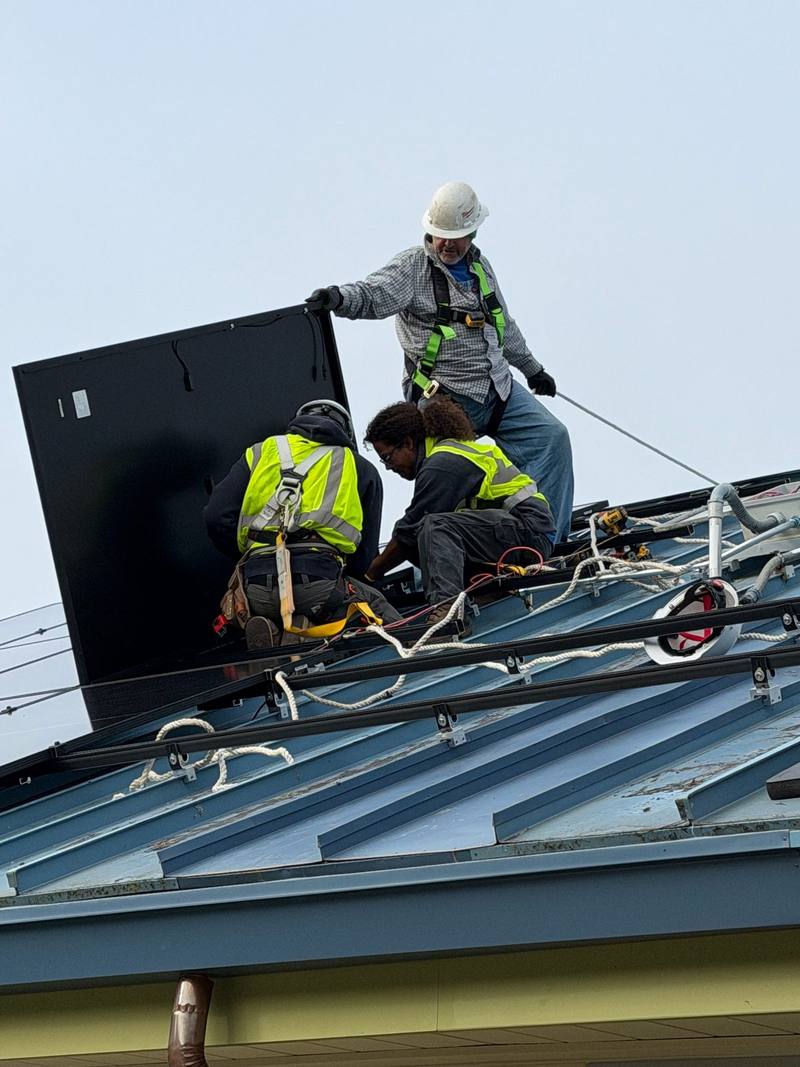
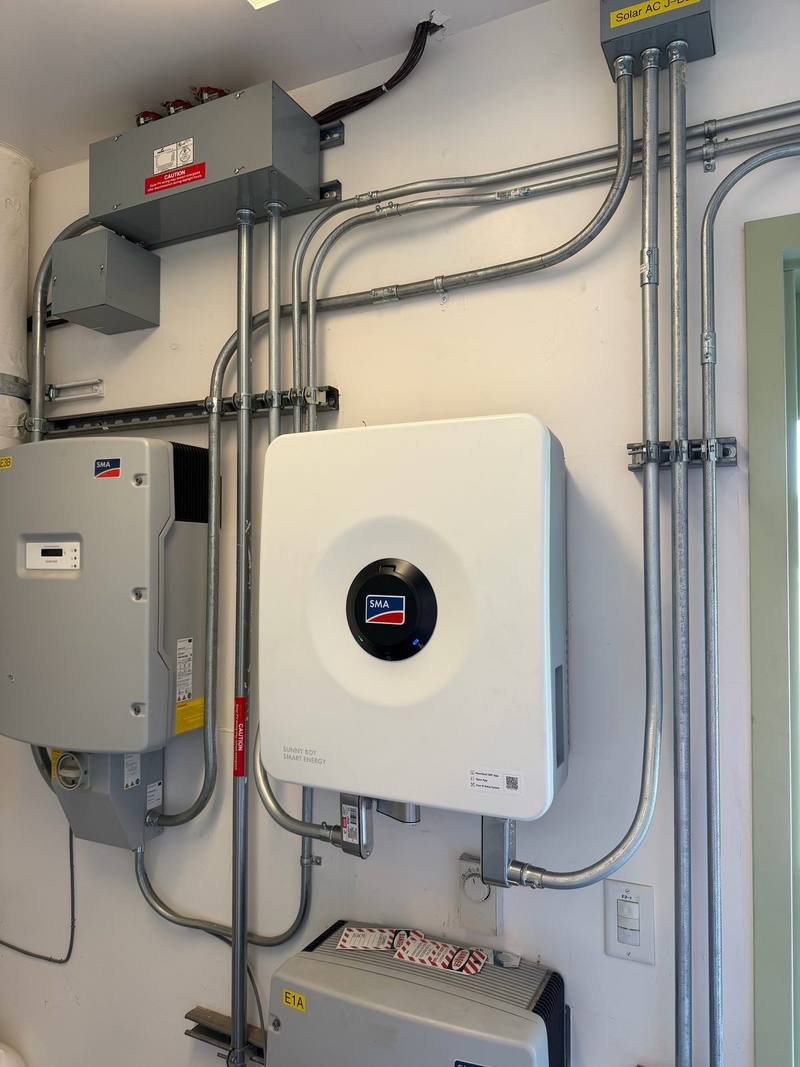
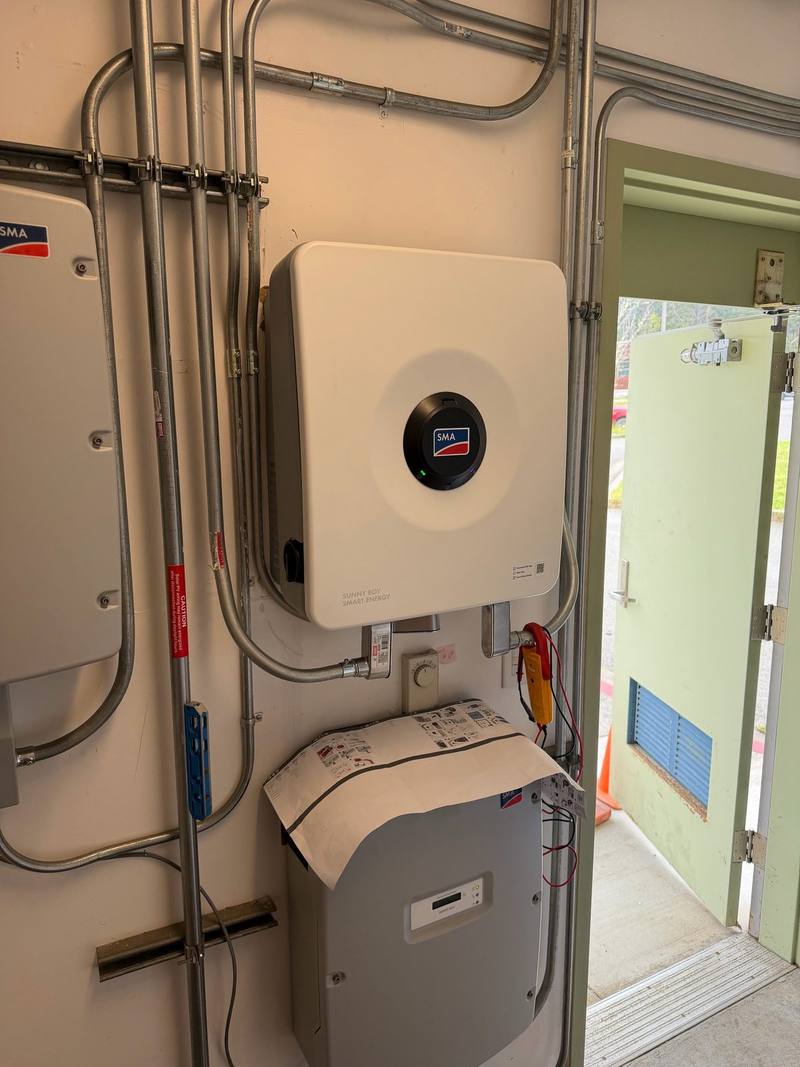
We install new systems, and we repair ones that have stopped producing. One of our recent jobs was a solar repair at a school in Mendocino, where we coordinated with PG&E and the Division of the State Architect (DSA). Whether it’s a new system, an inverter that’s gone quiet or a battery you want to add, we’re glad to take a look. For the in-depth version, with net billing, sizing, the 120% rule, repairs and adding a battery, see solar, batteries and renewable energy.
What we do
- Solar installationFor homes, businesses and schools.
- Solar repairFinding out why a system stopped producing and fixing it.
- Inverter serviceInverter troubleshooting, repair and replacement.
- Battery storageBattery systems that store power for your home or business.
- Panel readiness and PG&E coordinationMaking sure your panel can take the system, and handling the utility steps.
What to compare in a home battery
Two numbers matter most: kWh is how much energy the battery stores (how long it lasts), and kW is how much power it can deliver at once (how much it can run at the same time). Beyond those, here’s what we look at on any spec sheet:
| What to compare | Why it matters |
|---|---|
| Usable energy (kWh) | The usable number, not the total, sets run time. Our run time calculator does the math. |
| Continuous and peak power (kW) | Continuous power is what it can run all day; peak covers motor starts like a well pump or air conditioner for a few seconds. |
| Inverter and solar pairing | Some batteries have an inverter built in, others use a separate one, and they connect to solar differently (AC- or DC-coupled). This decides what works with the solar you already have. |
| Whole home or backup panel | Backing up the whole panel needs more power; a smaller system can feed a backup panel with the essentials. |
| Expansion | Whether you can add more capacity later, and how. |
| Warranty | Years, plus a promised remaining capacity or energy throughput. Read both numbers. |
| Listing and chemistry | Look for a system listed to UL 9540 (UL Solutions). Chemistry affects weight, heat and lifespan. |
| Where it can go | The building and fire codes limit where batteries can be installed in a home, with clearances; some units are rated for outdoors and for hot or cold temperatures. We check with your building department. |
| Utility approval | A battery that works with solar is part of your PG&E interconnection, and the paperwork comes before it’s turned on. |
Batteries matter here because Public Safety Power Shutoffs can last from hours to several days (PG&E). We’ll look at your panel, your solar (if you have it) and what you want to keep on, then talk it through honestly. Prefer a generator? See what to compare in a generator.
From our jobs
How the job goes
- 1Call or send a quote request
Tell us whether it’s a new system, a repair or a battery. Photos of the inverter and panel help.
- 2Site look and estimate
We check the roof or site, the panel and the existing equipment, then give you a clear estimate.
- 3Permit
We apply for the permit with your city or county.
- 4Install or repair, then inspection
We do the work and meet the inspector for the final permit.
- 5PG&E interconnection
The application goes to PG&E. The system stays off until PG&E gives written Permission to Operate.
Permits, inspections and PG&E
Inside Auburn city limits, electrical permits come from the City of Auburn Building Division, which takes permit applications online. In unincorporated areas, such as North Auburn, it’s Placer County Building Services. Elsewhere it’s that city or county’s building department. We pull the permit, schedule the inspection and meet the inspector.
Placer County offers SolarAPP+, an automated plan review for residential roof-mounted solar and energy storage (Placer County Building Services). The City of Auburn publishes a PV submittal checklist.
After the inspection, the interconnection application, a single-line diagram and the final permit go to PG&E. PG&E says not to turn the system on until you have its written Permission to Operate (Getting started with solar, how interconnection works).
From our Google reviews
… I had two damaged solar panels that needed replacing. Unfortunately the manufacturer had gone bankrupt. Walter went the extra mile, searched on the internet and found some in Los Angeles.
5.0 on Google · 108 reviews Read all our reviews on Google →
Common questions
Do you repair solar systems you didn’t install?
Yes. We troubleshoot and repair existing systems, including inverters.
When can I turn my new system on?
After the final inspection and once PG&E gives written Permission to Operate. PG&E says not to switch it on before then.
Can I add a battery to my solar?
Often, yes. We check your existing system and panel and talk through the options.
Do you work on school and public projects?
Yes. We’ve done school solar work that needed coordination with PG&E and the Division of the State Architect (DSA).
Request a free quote
Free estimates, no pressure. Tell us a little about the job and we’ll get back to you. Or call (530) 401-7419, answered 24/7.
Official sources
- City of Auburn Building Division www.auburn.ca.gov
- Placer County Building Services www.placer.ca.gov
- City of Auburn: Building forms and checklists www.auburn.ca.gov
- PG&E: Getting started with solar www.pge.com
- PG&E: How interconnection works when installing solar help.pge.com
- UL Solutions: Energy storage system testing and certification (UL 9540) www.ul.com
- PG&E: Public Safety Power Shutoffs (PSPS) www.pge.com
Permit and utility information checked against the sources above in November 2026. Rules and processes can change; your city or county building department and PG&E have the final word.