The problem with old dimmers
Before the 1960s, dimming a light usually meant a big rheostat or transformer that was bulky and wasted power as heat. That kept dimmers out of most homes.
Sources: National Geographic: Inventor turned up energy savings by dimming the lights (2010) National Academy of Engineering: Memorial Tributes, Joel S. Spira
A physicist in a spare bedroom
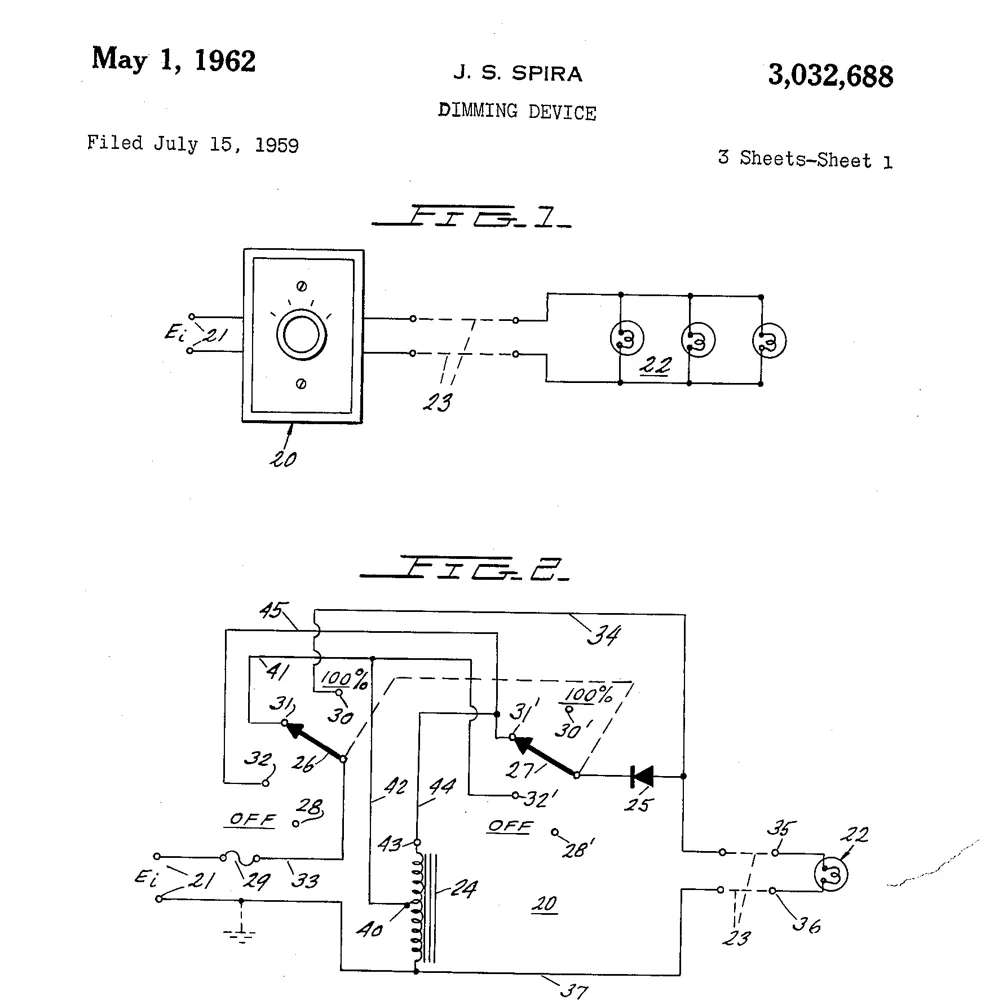
Joel Spira, a physicist, worked on a better dimmer in a spare bedroom of his Manhattan apartment. He filed a patent for a “dimming device” in July 1959, granted in May 1962. That early design used a diode and an autotransformer. He and his wife, Ruth Rodale Spira, founded Lutron in 1961, and the company later moved to Emmaus, Pennsylvania.
Sources: Google Patents: US 3,032,688, “Dimming device,” J. S. Spira (filed 1959, granted 1962) National Geographic: Inventor turned up energy savings by dimming the lights (2010) The New York Times: Joel Spira, physicist who softened the lights in homes everywhere, dies at 88 (2015) National Academy of Engineering: Memorial Tributes, Joel S. Spira
The solid-state dimmer
Lutron is credited with the first solid-state dimmer small enough to fit in a standard wall box. Instead of burning off the extra power, it uses a semiconductor switch (a thyristor) that turns the power on part way through each half of the AC wave. National Geographic calls it the first such dimmer to be mass-marketed.
Sources: National Geographic: Inventor turned up energy savings by dimming the lights (2010) National Academy of Engineering: Memorial Tributes, Joel S. Spira The New York Times: Joel Spira, physicist who softened the lights in homes everywhere, dies at 88 (2015)
In the Smithsonian
A Lutron “Capri” dimmer from about 1964 is in the collection of the Smithsonian’s National Museum of American History, part of a donation of company history in 2010.
Sources: Smithsonian National Museum of American History: Lutron “Capri” lamp dimmer Smithsonian NMAH press release: Lutron Electronics donates company history (2010)
Lutron today
Joel Spira died in April 2015 at 88, with more than 300 patents to his name. Lutron is based in Coopersburg, Pennsylvania, and reports at the time said it would stay family-run. Today it makes dimmers and lighting controls, including the Caséta smart-lighting line, and larger whole-home lighting systems such as RadioRA 3.
Sources: The New York Times: Joel Spira, physicist who softened the lights in homes everywhere, dies at 88 (2015) TWICE: Lutron to remain family-run (2015) Lutron: Caséta smart lighting Lutron: RadioRA 3
This is a history, not an endorsement. IES isn’t affiliated with Lutron, and its name and product names are trademarks of their owners. We use plain text, not logos.